
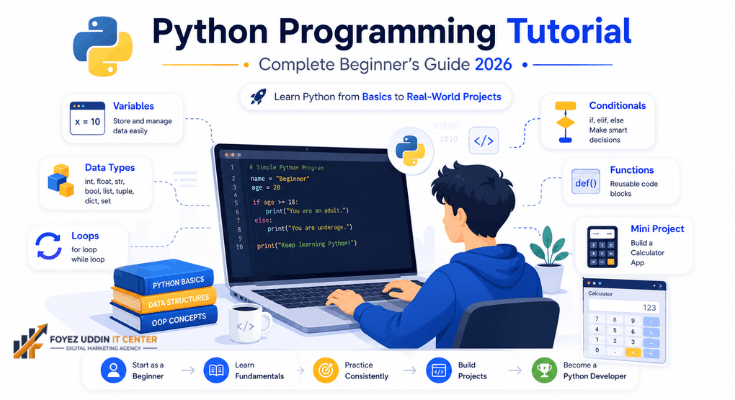
So you’ve been hunting for a Python programming tutorial that actually makes sense? Good news, you found it.
This guide takes you from “I’ve never written a line of code” to writing real, working Python programs. No fluff, no jargon overload. Just a clear path forward.
Maybe you want to build websites. Maybe you’re itching to dig into data. Or maybe you’re eyeing that AI career shift everyone’s talking about. Whatever the reason, this Python programming tutorial gives you the groundwork to get there.
Here’s the thing: Python isn’t just popular; it’s everywhere. That’s exactly why so many people search for a solid Python programming tutorial every day; they want a language that actually pays off. And this guide has you covered. We’ll walk through installation, syntax basics, data types, loops, functions, and a few hands-on projects so you’re not just reading; you’re actually building.
Why This Python Programming Tutorial Matters
Thousands of people start a Python programming tutorial every single month. And most of them? They bail before the halfway mark. Two reasons: usually either the content jumps way over their heads or it stays so basic they never actually learn anything useful.
This guide dodges both problems. We stack ideas one on top of the other, slowly, so by the end you’re not just skimming along. You’re writing code that actually runs.
A Python programming tutorial worth your time answers what beginners genuinely want to know, not just what sounds good in a headline. So we shaped this one around real questions people type into Google, then paired that with a walkthrough you can follow with your own hands.
Think back to the last time you tried learning something new from a random tutorial online. You probably hit one of two walls. Either it assumed you already spoke the lingo, or it crawled along so slowly you lost interest before anything useful showed up. This Python programming tutorial aims for that middle ground, enough meat to actually understand what’s going on without burying you in theory you don’t need on day one.
What You Need Before Starting This Python Programming Tutorial
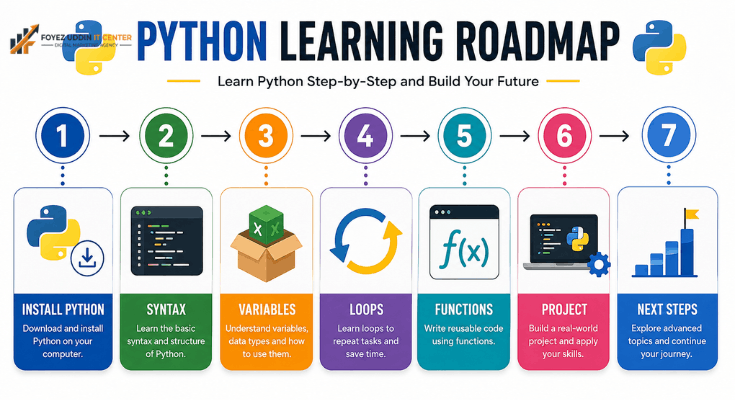
Before diving in, round up these four things:
- A computer: doesn’t matter if it’s Windows, macOS, or Linux
- Python itself, straight from python.org
- Code editors VS Code and PyCharm are both solid picks
- Curiosity. Honestly, that’s the big one. No coding background required to follow this Python programming tutorial
Look at what’s missing from that list. No degree. No math prerequisite. No pricey software. Python was designed to be approachable from the ground up, and this Python programming tutorial follows that same spirit from step one.
Step 1: Installing Python (Yep, Every Python Programming Tutorial Starts Here)
There’s no way around it; every Python programming tutorial has to start with installation first. Let’s get through it quick.
- Go to python.org/downloads
- Pick the latest stable version
- When setup asks, check “Add Python to PATH.” This one’s easy to miss, but skip it and you’ll be troubleshooting later for no good reason
- Pop open your terminal and run python –version to make sure it actually worked
Done? Nice. That’s it; you’re set up and ready to move through the rest of this Python programming tutorial.
One more thing before you move on. Windows users, if the installer pops up asking for admin permissions, just click yes. Looks intimidating, doesn’t it? It’s just how Python installs correctly on your machine. Mac and Linux folks usually sail through this part without any extra pop-ups at all.
Step 2: Understanding Python Syntax
Syntax shows up in every Python programming tutorial eventually; no way around it. But here’s the good part: this is exactly where Python earns its reputation. Line it up next to most other languages, and Python reads almost like something you’d say out loud, which is a big reason beginners take to it so fast.
python
Your first Python program
print(“Hello, World!”)
See that line? That’s the “hello” every Python programming tutorial opens with. Run it, and you’ve just given your computer an instruction and watched it actually follow through.
So what sets Python’s syntax apart from something like Java or C++? No pile of curly braces. No semicolons scattered everywhere. Python leans on indentation, just spacing, to keep code organized. Cleaner to look at, and it quietly trains you to write tidy code even before you realize you’re doing it.
Step 3: Variables and Data Types
Now let’s talk about how Python holds onto information, a piece every Python programming tutorial needs to cover.
python
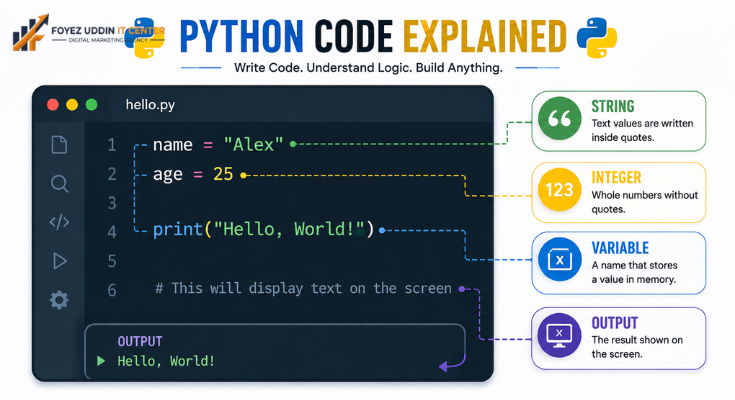
name = “Alex” # string
age = 25 # integer
height = 5.9 # float
is_student = True # boolean
Slow down here. For real. Ask anyone who’s hit a wall later in a Python programming tutorial, and there’s a good chance they rushed past data types early. Give this part a little extra time; you’ll thank yourself later.
Picture variables as boxes with labels stuck on them. Drop a value inside, name the box, and Python knows exactly where to find it whenever you need it again. Text goes in strings, whole numbers go in integers, decimals go in floats, true-or-false answers go in booleans. That’s really all there is to it.
Here’s a nice bonus: Python figures out the data type on its own. You never have to announce “hey, this is a string” or “this one’s a number.” Just assign the value and move on. Python handles the rest quietly in the background, one fewer thing pulling your attention while you’re still finding your footing.
Step 4: Working with Loops and Conditionals
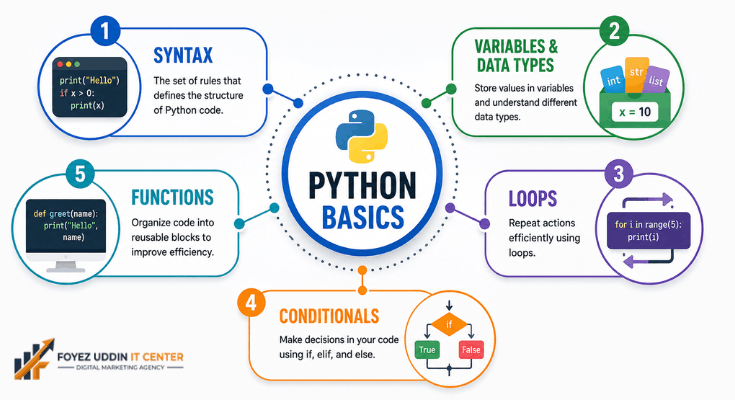
Skip loops and conditionals, and you’re not really running a Python programming tutorial anymore. These two pieces are what give your program the ability to actually think, instead of just sitting there doing nothing.
python
for i in range(5):
if i % 2 == 0:
print(i, “is even”)
else:
print(i, “is odd”)
Keep an eye out for this combo: a for loop stacked with an if statement. You’ll spot it in nearly every Python programming tutorial you come across. And once this pattern makes sense to you, a whole lot of other coding concepts suddenly start falling into place too.
Here’s a quick way to picture it. A loop is basically you telling Python, “Do this five times, ten times, whatever; just don’t make me type it out over and over.” A conditional, on the other hand, is your program hitting a fork in the road and picking a direction based on what’s true right now. Get comfortable with both of these, and you’ve cleared one of the toughest hurdles in learning to code. Seriously.
Step 5: Functions in Python
This is the moment a Python programming tutorial stops feeling like homework and starts feeling like actual programming. Functions tend to be where beginners have their first real “wait, I get this” moment.
python
def greet(user):
return f”Hello, {user}!”
print(greet(“Sarah”))
So why bother with functions at all? Simply write the code once and use it as many times as you want. No more copy-pasting the same five lines everywhere you need them. Wrap it up, name it, and call it whenever. Less typing. Fewer bugs sneaking in. Code that’s easier to read later.
Here’s something worth knowing: almost everything you build after finishing this Python programming tutorial will lean on functions, dozens of them, sometimes way more, all working together behind the scenes. Get good at writing them now, and trust me, everything after this gets noticeably easier.
Step 6: A Simple Hands-On Project
Reading only takes you so far with something like this. A Python programming tutorial that never asks you to actually build anything isn’t doing its job. So let’s fix that time to build a basic calculator.
python
def calculator(a, b, operation):
if operation == “add”:
return a + b
elif operation == “subtract”:
return a – b
else:
return “Invalid operation”
print(calculator(10, 5, “add”))
Run it yourself. Then go break it on purpose: swap the numbers, throw in a “multiply” option, or type something totally random for the operation and see what happens. This is the part where actual learning kicks in. Skimming through a Python programming tutorial without touching the keyboard just doesn’t compare.
Once this feels easy, push it further. Add a couple more operations. Or wrap the whole thing in a loop so it keeps asking for new numbers instead of running once and calling it done. These small changes are what turn a plain exercise into something that actually feels like yours.
Conclusion
Quick recap before you go. This Python programming tutorial took you through installing Python, getting a feel for syntax, working with variables and data types, using loops and conditionals, writing your own functions, and building a real project from scratch, plus answered the questions beginners ask most often.
Here’s something worth hearing straight: reading this one time isn’t going to turn you into a Python developer. Nobody gets there just by reading. Loop back to this Python programming tutorial as many times as it takes. Rebuild the calculator. Mess with it. Break something. Fix it. Repeat.
If this Python programming tutorial gave you a solid starting point, bookmark it now; you’ll want it later. Pass it along to that friend who keeps saying “I’ll learn to code someday.” And more than anything, open your editor and write something right now. That’s the one step nothing else can replace.
Frequently Asked Questions
Is Python good for beginners?
Yes, and honestly it’s not even close. Python’s clean, readable syntax is exactly why nearly every Python programming tutorial points beginners toward it first. Less time wrestling with confusing rules. More time actually solving the problem in front of you.
How long does it take to learn Python?
Stick with it for 4 to 8 weeks, and you’ll be writing basic programs without breaking a sweat by the end of this Python programming tutorial. Real mastery? That takes longer. But it comes down to how much you actually build, not how many pages you read.
What can you build after finishing this tutorial?
More than you’d guess. Work through this Python programming tutorial, and you’ll walk away able to build web apps, automate boring tasks, dig into data analysis, put together simple games, or even take your first steps toward machine learning.
Do I need math to follow along?
Not really. Basic logical thinking carries you the whole way. Sure, some advanced stuff like data science leans on math more heavily, but this beginner-level Python programming tutorial never assumes you walked in knowing any of that.
Which is better: Python or JavaScript for beginners?
Both have loyal fans. But most instructors steer beginners toward Python first, and for good reason the syntax is simpler, so working through a Python programming tutorial feels a lot smoother than jumping straight into an equivalent JavaScript guide.



One Comment on “Python Programming Tutorial: Complete Beginner’s Guide 2026”