
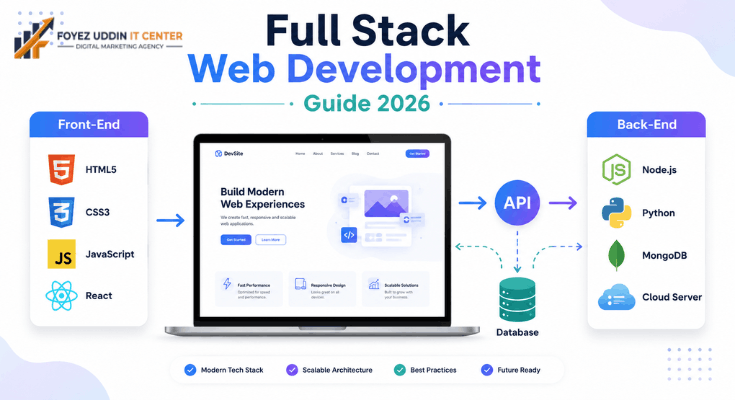
If you’ve been researching full-stack web development, you’ve probably noticed how many different skills the field seems to demand. This guide breaks it all down into a clear, structured path so you can understand exactly what it involves and how to start learning it, step by step.
By the end of this article, you’ll have a solid understanding of full-stack web development, what it means, which technologies you need, and how to build a career around it.
What Is Full Stack Web Development?
Here’s the simple version: Full stack web development means you build both sides of a website. The front-end is what people actually see and click on. The back end is everything running behind the scenes: servers, databases, all that plumbing.
A full-stack developer touches all of it. They jump from the browser to the server to the database and back again.
Why Does Everyone Want Full Stack Developers?
Think about it from a company’s perspective. Why hire two people when one person can handle both the design side and the logic side? That’s exactly why businesses big and small chase full-stack talent.
One hire, double the coverage. It saves money, adds flexibility, and honestly, it’s why the paychecks in this field stay so competitive.
Is It Actually Hard to Learn?
Let’s be honest: “hard” isn’t quite the right word. It’s more like… a lot. You’ve got HTML, CSS, JavaScript, some back-end language, databases, and Git, all stacked on top of each other.
Try to swallow it all at once, and you’ll choke. Take it one piece at a time, though, and it stops feeling overwhelming. That’s really the whole trick.
The Two Sides of Full Stack Web Development
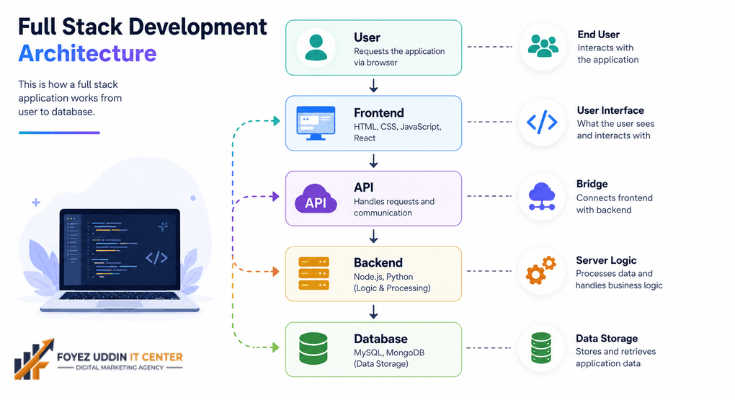
Front-End Development
The front-end is everything you can see and touch on a website. Layout, design, buttons, forms all of it. Three technologies do the heavy lifting here:
- HTML: builds the actual skeleton of the page
- CSS: makes it look good (colors, spacing, fonts, all that)
- JavaScript: brings it to life with interactivity
Most projects these days also lean on frameworks like React, Vue, or Angular. They speed things up and keep messy interfaces from turning into a nightmare to maintain.
Back-End Development
The back-end is the part nobody sees, but everything depends on it. Logic, data processing, server communication it’s all happening backstage. You’ll usually find one of these languages running the show:
- Node.js (JavaScript)
- Python
- PHP
- Java
- Ruby
This is also where the database connections live, where authentication happens, and where the real business logic sits.
What Skills Do You Actually Need?
HTML and CSS: The Starting Line
Everyone starts here, no exceptions. HTML builds the structure. CSS makes it look right with spacing, colors, and fonts and makes sure it doesn’t fall apart on mobile.
JavaScript: The Glue That Holds It Together
JavaScript runs the whole show. It handles interactivity on the front-end, and thanks to Node.js, it works on the back-end too. One language on both sides of the stack is a pretty good deal.
Pick a backend language and framework
Node.js with Express. Python with Django or Flask. PHP with Laravel. Whichever you pick, this decision shapes how you’ll write your server-side logic for a long time. Choose it carefully.
Databases
You need somewhere to put all that data and somewhere to pull it back from. Two main flavors exist:
- SQL databases (MySQL, PostgreSQL) think neat rows and tables
- NoSQL databases (MongoDB) have more flexible, document-style storage
Git and GitHub
Git tracks every change you make. It lets your whole team work on the same code without stepping on each other’s toes. You’ll use it every single day, so get comfortable with it early.
APIs and RESTful Services
APIs are the messengers between your front-end and back-end. Learn how to build them, and learn how to use ones other people built. This skill shows up constantly on the job.
Deployment and Hosting
A finished project sitting on your laptop helps no one. Get it live. Learn Vercel, Netlify, Render, or AWS; this is the last real step before your work actually counts as done.
Your Roadmap to Learning Full Stack Web Development
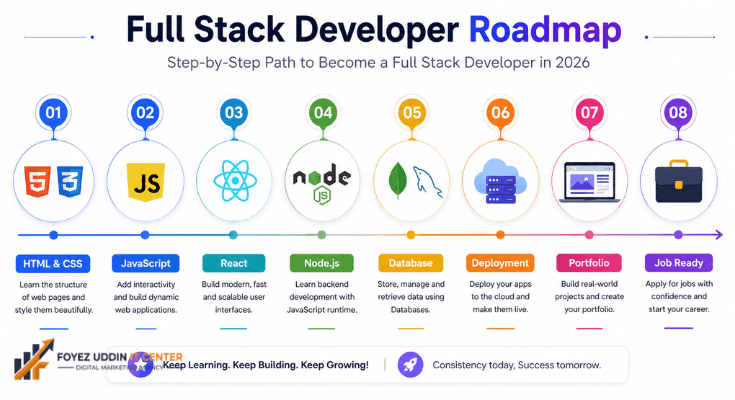
- Start with HTML and CSS. Build a few plain static pages. Nothing fancy; just get comfortable with structure and styling.
- Move on to JavaScript. This is where your pages stop sitting there and start actually doing things.
- Pick up a front-end framework. React’s the go-to choice heading into 2026, and for good reason.
- Learn a back-end language. Node.js makes sense here; it’s the same language you already know from the front-end, so there’s less to relearn.
- Get your hands on databases. Practice pulling data in and out, using both SQL and NoSQL setups.
- Now build real projects. Stitch your front-end and back-end together into something whole. This is where you actually find out if you know what you’re doing.
- Learn how to deploy. A project stuck on your laptop isn’t much use to anyone; get it online where people can see it.
- Put together a portfolio. Pick your best 3 to 5 projects and let them do the talking when employers come looking.
Where to Actually Learn This Stuff (Free and Paid)
- freeCodeCamp is free, and you learn by building, not just reading. Covers the whole stack.
- The Odin Project is also free, and it lays everything out in a clear order so you’re never wondering what’s next.
- MDN Web Docs is your go-to reference whenever you forget how something in HTML, CSS, or JavaScript actually works.
- YouTube channels like Traversy Media and Programming with Mosh are gold, and they won’t cost you a cent.
- Udemy and Coursera: If you want more hand-holding, these paid courses give you a structured path to follow.
The Stacks Everyone Talks About
- MERN: MongoDB, Express, React, Node.js
- MEAN: MongoDB, Express, Angular, Node.js
- Django Stack: Python, Django, PostgreSQL, plus React or plain JavaScript
- LAMP: Linux, Apache, MySQL, PHP
Here’s the thing: don’t try to learn all four. Pick one, get really good at it, and go deep. That’ll take you a lot further than skimming the surface of everything.
Mistakes That’ll Slow You Down
- Diving into frameworks before you’ve actually nailed JavaScript
- Putting off databases until way too late
- Building projects but never actually deploying them
- Learning tools in a vacuum instead of putting them together into real apps
- Measuring yourself against other people instead of just running your own race
Skip these, and honestly, your whole learning experience gets a lot smoother.
Where Can This Actually Take You?

Full-stack developers get hired pretty much everywhere: startups, agencies, online stores, finance companies, healthcare, you name it. You’ll see job titles like “Full Stack Developer,” “Web Application Developer,” or just plain “Software Engineer.”
And here’s the real perk: since you can handle both front-end and back-end work, you’re not boxed into one narrow lane. That flexibility usually means more job security than someone who only specializes in one piece of the puzzle.
Wrapping This Up
Honestly, full stack web development might be one of the smartest skills you can build in tech right now. You’re combining front-end design, back-end logic, databases, and deployment all in one package companies genuinely fight over.
Here’s the secret, though: you don’t need to memorize every tool out there. Nail HTML, CSS, and JavaScript first. Then slowly work your way into back-end stuff, databases, and real projects.
Doesn’t matter if you go with MERN, a Python setup, or something completely different. Showing up consistently and actually building things beats knowing every tool by name. Start simple, build real stuff, and you’re already on your way.
Quick Questions People Always Ask
So, what actually is full-stack web development?
Simply put, it’s building both halves of a web app. The part users see (front-end) and the part running things behind the curtain (back-end).
How long until I’m actually good at this?
Most people get job-ready in 6 months to a year, as long as they keep showing up and practicing.
Do I need a CS degree?
Nope. Plenty of great developers taught themselves or came up through a bootcamp instead of a four-year degree.
Which stack should I learn first?
MERN’s a solid bet: MongoDB, Express, React, and Node.js. You get to use JavaScript for everything, which cuts down on what you need to learn.
Is this still a good career going into 2026?
Yeah, definitely. Companies keep wanting people who can do both front-end and back-end; that demand isn’t slowing down.
What kind of money can I expect?
It depends a lot on where you live and how much experience you’ve got. Entry-level usually lands somewhere between $60K and $85K, and experienced devs can clear $120K without much trouble.
Can I really learn this without spending money?
You can. freeCodeCamp and The Odin Project both offer complete curriculums, and neither one costs you a dime.



4 Comments on “Full Stack Web Development: Complete Beginner’s Guide 2026”