
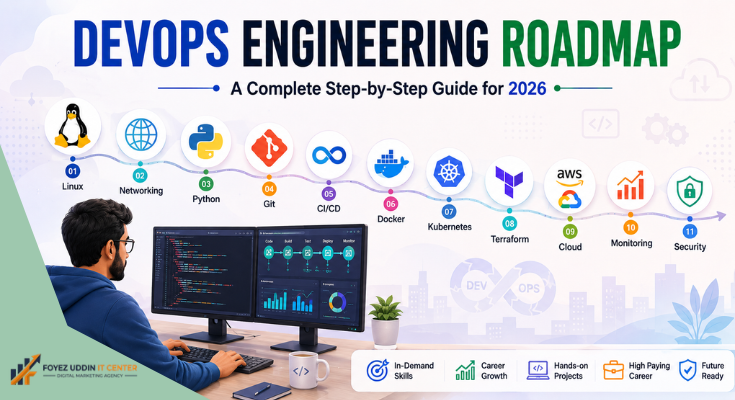
Thinking about building a career in DevOps? You need a clear DevOps engineering roadmap first. Otherwise you’ll end up guessing your way through it, and that wastes time you don’t have.
This guide walks you through the whole DevOps engineering roadmap in plain English. No jargon-heavy explanations, no assuming you already know half the terms. Just a straightforward path from “I have no idea where to start” to “I’m job-ready.”
A lot of people type “how to become a DevOps engineer” or “roadmap for beginners” into Google, and honestly, most of what comes up is either too technical or barely scratches the surface. So here’s the full version: tools, skills, certifications, and the questions people actually ask about this career.
What Is DevOps, and Why Do You Need a Roadmap for It?
DevOps mashes together two words: “development” and “operations.” It’s a way of working that gets your dev team and your IT operations team talking to each other instead of throwing work over a wall and blaming each other when things break. The whole point is to build, test, and ship software faster without everything falling apart in the process.
Here’s the thing about DevOps: there’s a lot to learn. Tools, concepts, platforms, all of it. Beginners get overwhelmed fast, and that’s exactly why a proper DevOps engineering roadmap matters so much. Skip the roadmap, and you’ll bounce between random YouTube tutorials for months without actually getting anywhere. A structured plan keeps you pointed in one direction and stops you from wasting time on the wrong things first.
Who Is This DevOps Engineering Roadmap For?
Honestly, this works for a bunch of different people:
- Fresh graduates trying to break into IT
- System admins looking to move into DevOps
- Developers who want to get hands-on with deployment and automation
- Working professionals ready for a career switch
Doesn’t matter where you’re starting from. This roadmap shows you what to tackle first and what can wait.
The Step-by-Step DevOps Engineering Roadmap
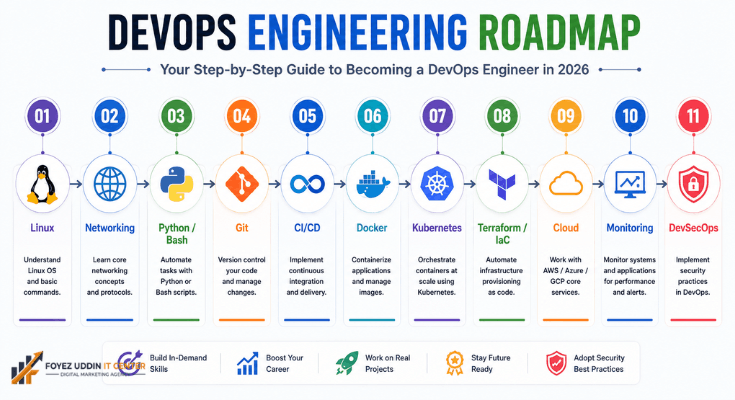
Let’s get into it. Here’s the whole thing, broken down step by step.
Step 1: Get Comfortable With Linux
Every solid DevOps engineering roadmap starts here. Most servers run on Linux, so this isn’t optional. You’ll want to learn:
- Basic Linux commands
- File permissions and users
- Process management
- Shell scripting basics
Almost every DevOps tool you’ll touch later runs on top of Linux. Skip this step, and everything after it gets harder than it needs to be.
Step 2: Learn Networking Basics
Next up: networking. This part trips a lot of beginners up, but you need it. Cover:
- IP addresses and DNS
- HTTP and HTTPS
- Firewalls and load balancers
- Ports, and how servers actually talk to each other
Without this, you won’t really understand how your applications connect and communicate. Don’t skip it just because it feels dry.
Step 3: Pick Up a Programming or Scripting Language
You don’t need to become a full-blown software engineer. But you do need at least one scripting language. Good options:
- Python (the go-to choice for most people)
- Bash scripting
- Go (optional, but useful once you’re past the basics)
Scripting is how you automate the boring stuff. And automation is basically the whole point of DevOps.
Step 4: Learn Git
Nearly every team uses Git, so this one’s non-negotiable. Get comfortable with:
- Core commands: clone, push, pull, merge
- Branching strategies
- Working in GitHub or GitLab
Once you know Git, working alongside other developers stops being a headache.
Step 5: Learn CI/CD
CI/CD, continuous integration and continuous deployment, is a big one. Tools to know:
- Jenkins
- GitHub Actions
- GitLab CI/CD
CI/CD basically automates testing and deploying your code, which saves teams a ridiculous amount of time.
Step 6: Get Into Containers
Containers run the modern DevOps world. Here’s what to focus on:
- Docker basics
- Writing Dockerfiles
- Managing images and containers
Containerizing your apps makes them portable; you can move them anywhere without headaches. That’s why this step matters so much.
Step 7: Learn Container Orchestration
Once containers make sense, move on to orchestration with Kubernetes:
- Pods, deployments, services
- Scaling apps
- Managing clusters
Kubernetes shows up everywhere in the industry, so this stage pays off big time for your career.
Step 8: Learn Infrastructure as Code
IaC lets you manage servers with code instead of clicking around manually. Look into:
- Terraform
- Ansible
- CloudFormation
These tools make your infrastructure setup faster and a lot less prone to human error.
Step 9: Get Comfortable With Cloud Platforms
You can’t skip cloud knowledge. Pick at least one to start with:
- Amazon Web Services (AWS)
- Microsoft Azure
- Google Cloud Platform (GCP)
Most modern apps live on the cloud these days, so understanding one of these platforms well is essential.
Step 10: Learn Monitoring and Logging
Beginners tend to skip this, but don’t. Monitoring is what catches problems before they become disasters. Learn:
- Prometheus
- Grafana
- ELK Stack (Elasticsearch, Logstash, Kibana)
These tools let you keep an eye on how your applications are actually performing and catch issues fast.
Step 11: Pick Up Security Basics (DevSecOps)
Security can’t be an afterthought anymore. Cover:
- Basic security scanning tools
- Handling secrets and credentials properly
- Compliance basics
Once you fold security into your skill set, you become a much more well-rounded engineer.
Tools You’ll Use Along the Way
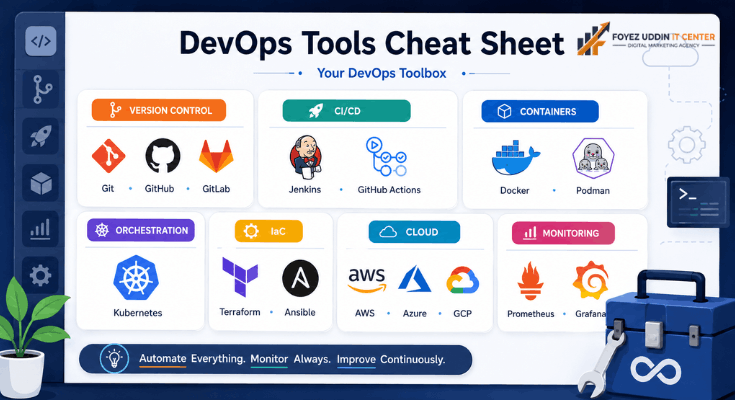
Here’s a quick cheat sheet of the tools that show up again and again:
| Category | Tools |
| Version Control | Git, GitHub, GitLab |
| CI/CD | Jenkins, GitHub Actions |
| Containers | Docker, Podman |
| Orchestration | Kubernetes |
| IaC | Terraform, Ansible |
| Cloud | AWS, Azure, GCP |
| Monitoring | Prometheus, Grafana |
Get comfortable with these, and you’ll be genuinely job-ready, not just familiar with the names.
How Long Does the DevOps Engineering Roadmap Actually Take?
People ask this constantly. Realistically, expect 6 to 12 months if you’re putting in consistent effort. It depends a lot on where you’re starting from, how many hours you can dedicate each day, and how much hands-on practice you’re getting. If you already know some programming or have sysadmin experience, you’ll likely move through it faster than someone starting from zero.
Certifications Worth Considering
You don’t need certifications to land a job, but they do add weight to your resume. Worth looking into:
- AWS Certified DevOps Engineer
- Certified Kubernetes Administrator (CKA)
- Microsoft Certified: DevOps Engineer Expert
- Docker Certified Associate
They’re proof you actually put in the work, and hiring managers notice that.
Why Is DevOps So In-Demand Right Now?
Companies want to ship features fast without breaking everything in production. That used to be a problem, because developers and operations teams worked in silos and pointed fingers when things went sideways. DevOps fixes that by getting both sides working together and automating away the repetitive stuff.
As more businesses shift to the cloud and adopt microservices, they need people who can handle deployment pipelines, infrastructure, and monitoring. That’s exactly why so many people are hunting for a clear path into this field right now.
Don’t Skip the Soft Skills
Knowing the tools isn’t enough on its own. Employers also want people who can:
- Talk clearly with both developers and ops folks
- Stay level-headed when something breaks at 2am
- Write documentation other people can actually follow
- Work well across different teams
Pair strong technical chops with these soft skills, and you’ll stand out a lot more than someone who’s purely technical.
What About Salary?
DevOps roles tend to pay better than a lot of other IT jobs, mostly because the role blends development, operations, and cloud know-how all in one. Entry-level pay starts lower, sure, but it climbs fast once you build real experience, especially with cloud platforms and container orchestration under your belt.
You’ll find openings in pretty much every industry: finance, healthcare, retail, tech startups, and you name it. Software runs everything now, so this demand isn’t going anywhere anytime soon.
What Jobs Can You Land After This?
Once you’ve worked through the roadmap, you’re looking at roles like the following:
- DevOps Engineer
- Site Reliability Engineer (SRE)
- Cloud Engineer
- Automation Engineer
- Platform Engineer
Companies across nearly every sector are hiring for these, which makes this a genuinely smart career move.
Mistakes to Avoid
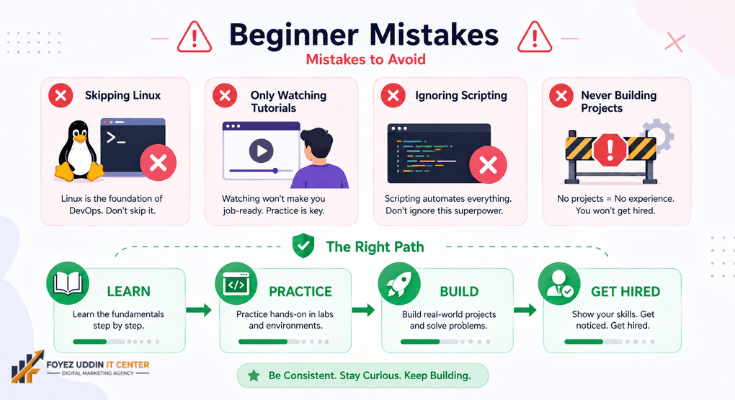
- Skipping the fundamentals. People jump straight to Kubernetes without ever touching Linux properly. Don’t do this.
- Watching without doing. Tutorials alone won’t cut it; you need to actually build things.
- Ignoring scripting. Automation is the whole point of DevOps. You can’t skip it.
- Never building real projects. Employers want proof you can do the work, not just a list of tools you’ve heard of.
Steer clear of these, and your progress speeds up dramatically.
Wrapping Up
A solid DevOps engineering roadmap is genuinely the fastest way to build a real career in this field. Start with Linux; work your way through scripting, Git, CI/CD, containers, and cloud platforms; and finish up with monitoring and security, and you’ll have every skill you need to call yourself a DevOps engineer.
Don’t rush it, though. Practice daily, build actual projects, and keep picking up new tools as the field evolves. Stick with it consistently, and you’ll be ready for real-world DevOps jobs within a year.
Frequently Asked Questions
What’s the best DevOps engineering roadmap for beginners?
Start with Linux, networking, and scripting. Then move into Git, CI/CD, Docker, Kubernetes, cloud platforms, and monitoring tools, in roughly that order.
Do I need to know how to code?
Yes, at least basic scripting in Python or Bash. Automation depends on it, so you can’t really skip this part.
Can non-IT graduates follow this roadmap?
Absolutely. Anyone with basic computer skills and enough patience can do this. It might just take a bit longer to build up the fundamentals.
Which cloud platform should I learn first?
AWS is the most common starting point since so many companies use it. Azure and GCP are solid too, depending on what’s popular in your local job market.
Do I actually need certifications?
Not required, but they help. Think of them as extra proof on your resume that backs up what you already know.
What kind of salary can I expect?
It varies by country and experience level, but DevOps engineers generally out-earn a lot of other IT roles because the demand is so high.
How do I actually practice these skills?
Build personal projects. Use free-tier cloud accounts. Contribute to open-source repos. Set up small CI/CD pipelines yourself; that hands-on practice is what actually sticks.