

Companies collect a ridiculous amount of data these days. But numbers sitting in a spreadsheet don’t help anyone. Someone has to make sense of them. That’s the job of a business intelligence analyst.
This person digs through numbers, spots trends, and builds reports that help a company make smarter calls. If you’re eyeing this career, you’ve probably already asked yourself, “What skills does a business intelligence analyst actually need?” or “Is this even hard to learn?” Good questions. Let’s answer them in plain English.
We’ll walk through the tools, the education path, the salary, the career growth, and what a normal workday looks like. There’s also an FAQ section at the end for the questions people search for most.
By the time you finish reading, you’ll know exactly what it takes to become a solid business intelligence analyst and how to get there yourself.
Who Is a Business Intelligence Analyst?
A business intelligence analyst gathers business data, cleans it up, and studies it closely. Their real job isn’t just staring at numbers. It’s finding the story hiding inside them and explaining what that story means for where the business is headed.
Picture someone doing this job at an online store. They notice a certain product spikes every winter. They pass that insight to the marketing team, and suddenly the company has a smarter plan for the season instead of just guessing.
That’s the whole point. A business intelligence analyst connects raw, messy data to real business decisions. Without that connection, companies end up guessing, and guessing gets expensive.
Why Business Intelligence Analyst Skills Actually Matter
Data pours in from everywhere: sales, customers, websites, social media, you name it. None of it means anything without the right skills to sort through it. A skilled business intelligence analyst can:
- Turn a mess of numbers into a report anyone can understand
- Catch patterns most people would scroll right past
- Help managers decide faster, with less second-guessing
- Save the company real time and real money
- Spot a trend before a competitor even notices it
- Back up marketing, sales, and finance teams with facts instead of hunches
That’s exactly why companies keep hiring people with strong business intelligence analyst skills, year after year. Banking, healthcare, retail, education, and tech: the demand shows up everywhere. Honestly, any company sitting on customer or sales data can use one.
Top Technical Business Intelligence Analyst Skills
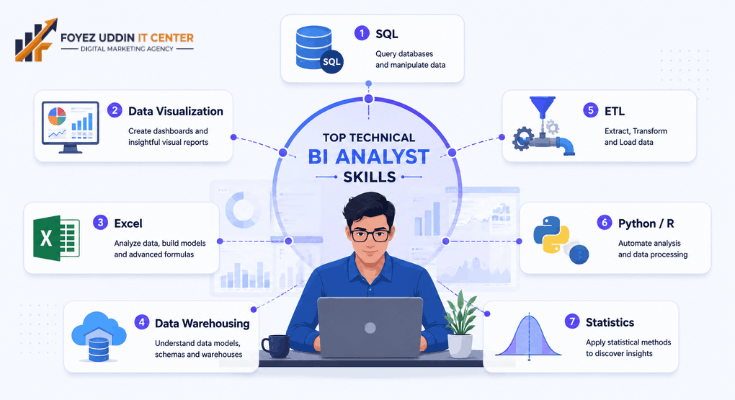
Here’s where things get practical. These are the technical skills that actually get a business intelligence analyst hired.
SQL (Structured Query Language)
SQL comes first, no contest. It’s how you pull data out of massive databases. Skip SQL, and you’re stuck; you simply can’t reach the raw data you need to build anything.
Data Visualization Tools
Numbers alone don’t convince anyone. You need to turn them into something people can actually look at. Power BI, Tableau, and Google Looker Studio are tools that turn boring spreadsheets into charts and dashboards that make sense at a glance.
Excel and Spreadsheet Skills
Fancy software gets all the attention, but Excel is still where a lot of the real work happens. Pivot tables, formulas, and quick macros; when you need an answer fast, Excel usually gets you there.
Data Warehousing
You need to know where the data actually lives. Systems like Snowflake, Amazon Redshift, and Google BigQuery store huge volumes of information, and knowing how to pull accurate, current data from them is non-negotiable.
ETL (Extract, Transform, Load) Process
Raw data is messy. ETL is the process that cleans it up and gets it ready to use. Moving data between systems without losing accuracy along the way? That’s a daily task in this job, not a nice-to-have.
Basic Programming Knowledge
More and more employers want to see Python or R on your resume. These languages help you dig deeper into the data and automate the boring, repetitive stuff so you’re not doing it by hand every week.
Statistics and Data Analysis
You need a feel for averages, trends, and probability. Why? Because sometimes a “trend” isn’t real; it’s just noise. Statistics helps you tell the difference before you make a call based on it.
Top Soft Skills for a Business Intelligence Analyst
Technical chops get you in the door. Soft skills are what make people actually trust your work.
Communication Skills
You have to explain complicated data using words a five-year-old could follow. Okay, maybe not that simple, but close. Not everyone in the room reads charts for fun, so clarity matters more than showing off.
Problem-Solving Ability
Data gets messy. Incomplete fields, weird formatting, missing values. It happens constantly. The people who thrive here don’t panic. They just fix it and move on.
Business Understanding
Knowing the tools isn’t enough. You need to understand how the business actually runs. Otherwise, your “insight” might be technically correct and completely useless to the people making decisions.
Attention to Detail
One wrong number can send a whole team down the wrong path. Good analysts double-check everything before it lands in front of leadership. It’s tedious, sure, but it saves everyone a headache later.
Critical Thinking
Don’t just report the numbers; question them. Ask why something happened, not just what happened. That’s the difference between reading data and actually understanding it.
Time Management
Deadlines pile up fast in this line of work. Learning to manage your time well means you can deliver accurate reports without a last-minute scramble every Friday afternoon.
Daily Tasks of a Business Intelligence Analyst
Curious what a normal Tuesday looks like? Here’s the rundown:
- Pulling data from different departments
- Cleaning up messy, disorganized data
- Building dashboards and visual reports
- Walking managers and teams through the findings
- Tracking how the company is performing over time
- Suggesting changes based on what the data shows
- Sitting down with stakeholders to figure out what they actually need
It’s a mix of technical grind and real business thinking. If you like solving puzzles and turning numbers into a story, being a business intelligence analyst scratches that itch.
How to Become a Business Intelligence Analyst
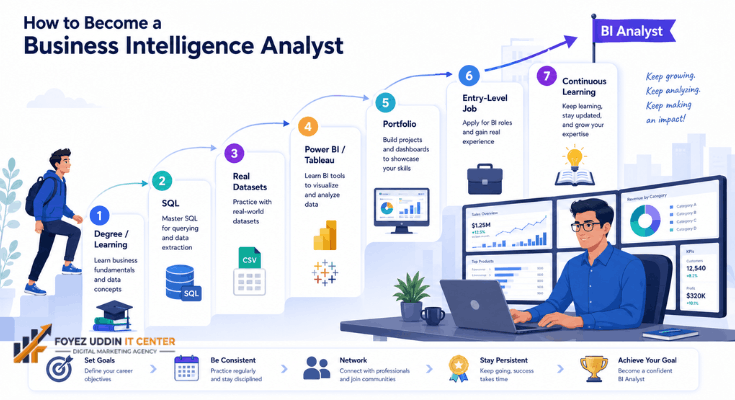
Want in? Here’s a straightforward path.
- Get a relevant degree: business, statistics, computer science, or economics all help. Not always required, but it doesn’t hurt.
- Learn SQL first: Seriously, start here. Almost every job in this field leans on it.
- Practice with real data: Grab free datasets online and start building your own dashboards.
- Pick up a visualization tool: Power BI or Tableau are solid starting points for beginners.
- Build a portfolio: Show off real reports and dashboards. Employers want proof, not promises.
- Apply for entry-level roles: Jobs titled “Data Analyst” or “Reporting Analyst” often turn into this exact role down the line.
- Keep learning: Tools change fast. Staying current isn’t optional; it’s part of the job.
Stick with it, and most people can build solid Business Intelligence Analyst skills within six months to a year, depending on how much time they can put in.
Certifications That Can Help
You don’t need a certificate to land a business intelligence analyst job, but it doesn’t hurt your chances. A few worth looking at:
- Microsoft Power BI Data Analyst Certification
- Tableau Desktop Specialist Certification
- Google Data Analytics Certificate
- SQL certifications through Coursera or edX
These show employers you put in real effort to build practical skills, not just theory.
Industries That Hire for This Role
Pretty much every industry needs someone who can make sense of data. A few examples:
- Banking and Finance: Watching spending habits, catching fraud, and tracking investments.
- Healthcare: Studying patient records to cut costs and improve care.
- Retail and E-commerce: Figuring out what customers buy and how much stock to keep.
- Technology: Measuring app usage, user growth, and how products actually perform.
- Education: Tracking student results and figuring out what teaching methods work.
Data touches nearly everything now, so a career as a business intelligence analyst isn’t boxed into one industry. That gives you room to pick a field you actually care about while using the same core skills.
Career Growth and Future Path
This isn’t a dead-end job by any stretch. Most people start as junior analysts and work their way up to senior data analyst, BI manager, data scientist, or even head of analytics. And as AI and automation take over more grunt work, the ability to explain data clearly to actual humans only gets more valuable, not less. Companies will always need someone who can turn a pile of numbers into a story leadership can act on. That’s a career with real staying power, not just a passing trend.
Business Intelligence Analyst Salary
Pay varies based on experience, location, and how big the company is. Generally speaking, this role pays well compared to a lot of other entry-level tech jobs, and it tends to climb quickly once you have a few years under your belt. Senior professionals with sharp business intelligence analyst skills can pull in even more, especially at big tech, finance, or healthcare companies where data drives almost every decision.
Common Tools Used in This Field
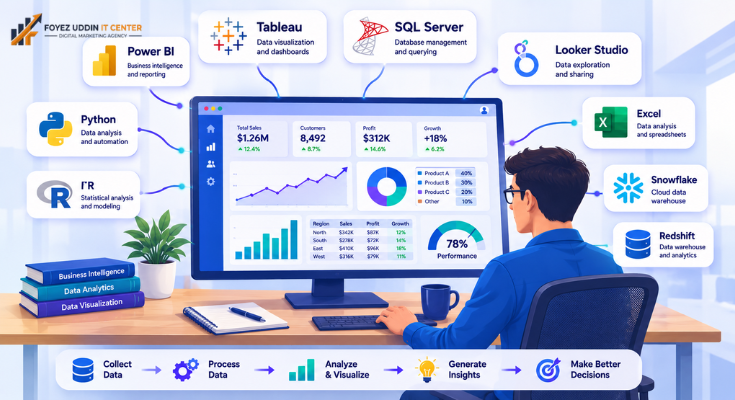
- Microsoft Power BI
- Tableau
- SQL Server
- Google Looker Studio
- Python and R
- Excel
- Snowflake and Amazon Redshift
Get comfortable with even two or three of these, and you’ll be job-ready as a business intelligence analyst a lot faster than you’d think.
Conclusion
Becoming a Business Intelligence Analyst isn’t as intimidating as it sounds. Learn SQL, Power BI, and Excel. Build up your communication and problem-solving skills alongside them. Do that, and you’ve got a real shot at a solid career in this field.
Companies aren’t going to stop needing people who can turn confusing data into decisions that actually move the business forward. So if you’re ready to start, begin with SQL, get your hands on real datasets, and add visualization tools as you go. One step at a time, you’ll get there, and you’ll come out the other side as a confident, capable business intelligence analyst.
Frequently Asked Questions (FAQs)
- What skills do I need to become a business intelligence analyst?
You’ll want SQL, a visualization tool like Power BI or Tableau, solid Excel skills, some statistics knowledge, and the ability to explain all of it clearly. That combination is the backbone of every business intelligence analyst career.
- Is coding required for a business intelligence analyst?
Not always, but it helps a lot. Basic Python or R can take your analysis a lot further, and plenty of employers now expect a business intelligence analyst to know at least the basics.
- What’s the difference between a data analyst and a business intelligence analyst?
A data analyst tends to work with data in a broader sense. A business intelligence analyst zeroes in more on business trends, dashboards, and how the company performs over the long haul.
- How long does it take to become a business intelligence analyst?
With consistent practice, most beginners can pick up the core skills in six months to a year. It really depends on how much time you put in.
- Is being a business intelligence analyst a good career choice?
Yes, honestly. Almost every industry needs someone in this role to make sense of their data, which makes it a pretty stable, steadily growing career path.
- Which tool should I learn first for this career?
Start with SQL. Then move on to Power BI or Tableau once you’re comfortable pulling and organizing data.
- Do I need a college degree to become a business intelligence analyst?
It helps, but it’s not a hard requirement. Plenty of people break into this field through online courses, certifications, and a strong portfolio of real projects.