
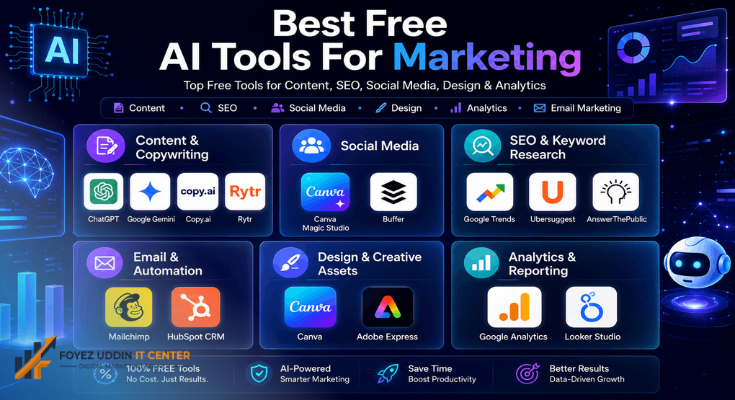
Finding the best free AI tools for marketing is harder than it sounds, because most “free” tools quietly funnel you toward a paid plan the moment you try to ship something real: a watermark shows up, an export button locks, or you hit a credit ceiling on day three. This roundup only includes tools I’ve actually used to produce work that went out the door, not demo versions that fall apart the second you need more than one sample output. I’ve run campaigns with most of these, and I’ll tell you where the free tier is genuinely generous and where it’s a bait-and-switch.
A quick word on how this list was put together: I didn’t pull it from press releases or “top 10” roundups that recycle the same names every year. Every tool below is something I’ve either used on a live campaign or watched a client use well enough that I’d recommend it without hesitation. If a tool’s free tier turned out to be too thin to be useful, it’s not here, and if I only half-trust a current limit, I’ve said so instead of guessing.
What Counts as the Best Free AI Tools for Marketing
Before the list starts, here’s the filter I used, because “free” gets thrown around loosely in this space. To make this list of the best free AI tools for marketing, a tool had to meet three conditions: a real free tier (not a 7-day trial disguised as one), usable output without a credit card on file, and enough monthly capacity to actually run a small campaign, not just test the waters.
A lot of tools technically have a free plan but cap you so tightly it’s more of an ad for the paid tier than a working option. I’ve left those off or flagged them clearly where they still made the cut with caveats. You’ll notice a few well-known names missing entirely; that’s intentional, not an oversight.
One more thing worth saying up front: free AI tools are genuinely useful, but they’re not a replacement for strategy. They speed up execution. They don’t replace knowing your audience, and no tool on this best free AI tools for marketing list will fix a campaign built on a bad idea.
I’d also add that “free forever” and “free tier” aren’t the same thing, and it’s worth knowing which one you’re getting into. A free tier from an established company (Google, HubSpot, or Mailchimp) tends to be more stable long-term than a free plan from a smaller AI startup still figuring out its business model; those can shrink or disappear with little warning. That’s not a reason to avoid the smaller tools, several of which are excellent, but it’s a reason to have a backup plan if one of them tightens its limits overnight.
Best Free AI Tools for Marketing: Content & Copywriting
This is where most people start, and it’s also where the gap between “free” and “usable” is widest.
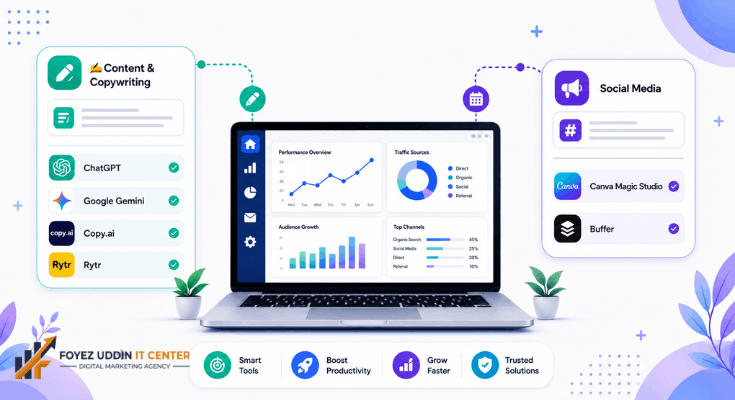
ChatGPT (free tier) is still the most practical starting point for copy headlines, ad variations, blog outlines, and email subject lines. The free tier gives you access to a solid general-purpose model with reasonable usage limits, though it caps out during peak hours and the most advanced reasoning model is gated behind the paid plan. Honestly, for day-to-day copywriting tasks, the free model is more than enough. Check current limits on OpenAI’s site.
Google Gemini (Free tier) is a strong alternative, especially if you’re already writing inside Google Docs or Gmail. It’s a bit more conservative in tone by default than ChatGPT, which some marketers prefer for B2B copy that shouldn’t sound too casual. You can try it directly at gemini.google.com.
Copy.ai (free plan) is worth mentioning specifically because it’s built around marketing templates rather than a blank chat box. Ad copy, product descriptions, and social captions all have dedicated flows. The free tier gives you a limited number of monthly credits, and you’ll burn through them faster than you’d expect if you’re generating a lot of variations. That’s the honest limitation: it’s genuinely useful, but the credit ceiling arrives sooner than the marketing copy on their homepage implies. More details at copy.ai.
If you only pick one tool from this section of the best free AI tools for marketing list, start with whichever general chat assistant you already have an account with. The templated tools add convenience, not fundamentally better output.
Worth mentioning too: Rytr’s free plan exists in this category and is fine for short-form copy, but I’ve found the character-per-month limit tight enough that it’s really only workable for a single small campaign a month, not ongoing use. It’s a reasonable backup, not a primary tool.
Best Free AI Tools for Marketing: Social Media
Social is where AI tools have gotten noticeably better over the last couple of years, mostly because the output finally looks less generic.
Canva’s Magic Studio (free tier) bundles AI writing, background removal, and image generation directly into the design editor, which matters more than it sounds like you’re not bouncing between four different tabs to get a finished post out. The free plan includes a real chunk of Magic Studio credits monthly, though the exact number shifts periodically, so it’s worth checking current allotments before you build a content calendar around it. See what’s included at canva.com.
Buffer (Free plan) isn’t an AI-first tool, but its free tier now includes AI-assisted caption suggestions and a genuinely usable scheduler for a small number of channels. If you’re a solo marketer or small team, the honest limitation here is channel count, not AI quality; you’ll hit the account limit before you hit an AI usage cap. Details at buffer.com.
For anyone building out a broader content calendar, it’s worth reading [Link to: Best AI Tools for Content Creation] alongside this section, since a lot of the copywriting and social tools overlap in practice.
One honest caveat across this whole category: AI-generated captions still need a voice check. I’ve seen more than a few brand accounts start sounding identical to every other account using the same tool, because everyone’s pulling from the same underlying model with the same default tone. Treat AI captions as a first draft you punch up, not a finished post, and this section of the best free AI tools for marketing list will actually earn its place in your workflow.
Best Free AI Tools for Marketing: SEO & Keyword Research
SEO tools are notorious for gating the useful data behind a paywall, so this category has fewer genuinely free standouts than the others.
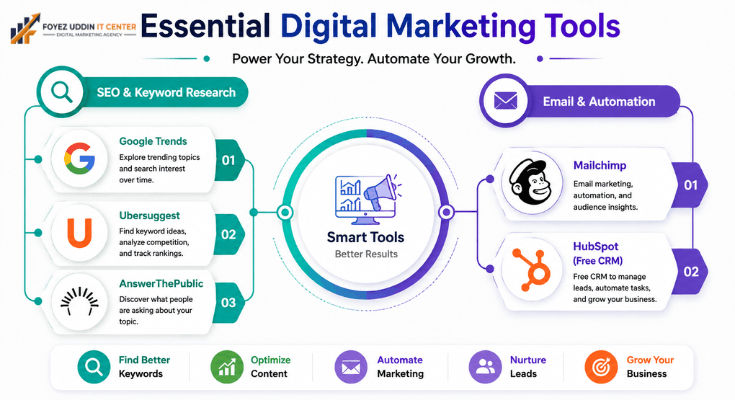
Google Trends isn’t marketed as an AI tool, but its trend-forecasting and related-query features are genuinely free, unlimited, and more reliable than most paid keyword tools for spotting rising topics early. It’s worth checking directly at Google Trends before you commit a budget anywhere else.
Ubersuggest (Free tier) gives you a limited number of daily searches for keyword volume, competition, and content ideas. The free cap is low enough that it’s really a “check a few keywords before a paid tool” utility rather than a full research workflow worth knowing going in so you’re not surprised when the searches run out mid-session.
AnswerThePublic (free tier) is useful specifically for content ideation; it surfaces the actual questions people are searching around a topic, which is harder to get from a straight keyword tool. The free plan limits you to a couple of searches per day, so treat it as a brainstorming session starter, not a daily-use tool.
This is one category where I’d genuinely recommend budgeting for a paid tool eventually. The free tiers here are useful for spot checks, but running full SEO research on free plans alone gets slow fast.
That said, don’t underestimate Google Trends specifically. Because it’s not gated in any meaningful way, it’s honestly one of the more slept-on entries on any best free AI tools for marketing list; a lot of marketers only reach for it during a seasonal campaign when it’s just as useful for everyday topic prioritization.
Best Free AI Tools for Marketing: Email & Automation
Email is where AI has quietly become useful in a boring, practical way: subject line testing, send-time suggestions, and basic segmentation logic.
Mailchimp (free plan) includes AI-assisted subject line suggestions and basic content generation within its free tier, capped at a limited contact count and monthly sends. For a small list, that’s genuinely enough to run real campaigns, not just tests. The honest limitation: once your list grows past the free threshold, you’re moving to a paid plan whether you like the AI features or not. Check current limits at mailchimp.com.
HubSpot’s free CRM and marketing tools include some AI-assisted email content help bundled into the free CRM tier, which is worth knowing about if you’re not already using it for contact management. It’s more limited on the marketing-automation side than the CRM side, so don’t expect full workflow automation without upgrading.
If you’re trying to decide whether to build your own stack from scratch or just centralize everything around one platform, this is the moment to actually think it through. Take a look at how dedicated content-and-learning tools compare. The AI Advantage for Students is a good reference point against going with one all-in-one marketing suite instead. Honestly, the right call comes down to your team size: if you’re small, one platform keeps things simple; if you’re bigger, picking the best tool for each job usually pays off more in the long run.
A small but real tip from running actual sends: use the free AI subject line suggestions as a starting point for an A/B test, not as the final answer. I’ve had the AI-suggested version win maybe half the time; it’s genuinely useful, but not a guaranteed upgrade over something you’d write yourself with your list in mind.
Best Free AI Tools for Marketing: Design & Creative Assets
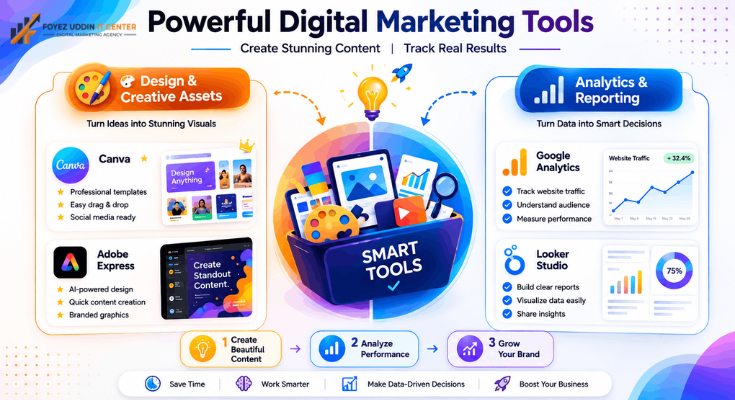
Canva (free plan), beyond Magic Studio specifically, remains the backbone of a lot of small marketing teams’ creative workflow templates, stock assets, and AI image generation all live in one place, and the free tier is genuinely usable for real output, not just previews. The limitation shows up mostly around premium templates and certain export formats, which sit behind Canva Pro.
Adobe Express (Free plan) is a reasonable alternative if your team already works in Adobe’s ecosystem elsewhere. Its free tier includes AI-assisted design suggestions and a solid template library, though the most advanced generative features are usage-capped.
Whichever you pick, this is a category where the free tier genuinely holds up for day-to-day social graphics and simple ad creative; you don’t need a paid plan until you’re producing at real volume.
If your team leans heavily on visual content, this is a category worth revisiting every few months, since design tools tend to update their free AI credit allotments more often than the copywriting or SEO tools above.
Best Free AI Tools for Marketing: Analytics & Reporting
This is the least glamorous category and also the one people skip most often when building out an AI marketing stack, which is a mistake since it’s where you find out if any of the above actually worked.
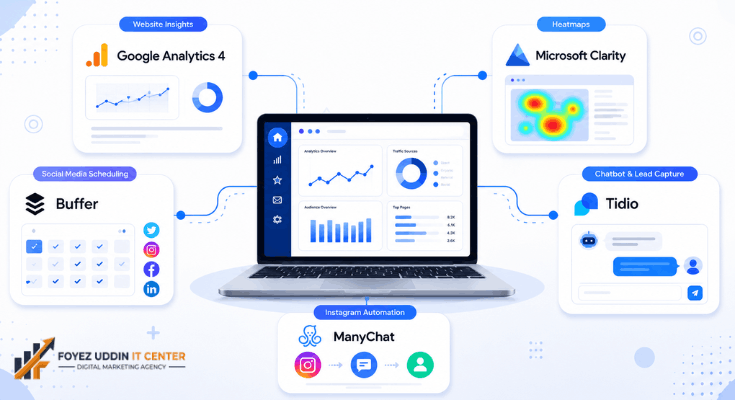
Google Analytics (Free) is still the standard, and its AI-driven insights panel flagging anomalies and surfacing trend shifts is genuinely free with no usage cap for most small-to-midsize sites. It’s worth setting up properly before you invest heavily in the tools above, since campaign output is hard to judge without it. Details at Google Analytics.
Looker Studio (Free) connects to Analytics and other data sources to build shareable dashboards, and it’s completely free with no meaningful cap for typical marketing use. The learning curve is the honest limitation here, not the price; it takes longer to set up a clean dashboard than most of the generation tools above.
Rounding out any serious best free AI tools for a marketing stack means including at least one measurement layer; otherwise, you’re just producing content without knowing what’s working.
Neither Google Analytics nor Looker Studio is flashy, and neither will show up on most influencer-recommended lists of AI tools, but they’re the two entries in this best free AI tools for marketing guide I’d be least willing to cut.
Building a Workflow: How These Tools Fit Together
Here’s what a real campaign launch looks like using tools from this list, not just a list of names with no context.
Say you’re launching a new product page and need a short campaign around it. You’d start in ChatGPT or Gemini drafting headline and email copy variations, then move into Canva to turn the winning headline into a handful of social graphics using Magic Studio for quick background and copy tweaks. Buffer schedules the posts across your channels, while Mailchimp handles the announcement email using one of the AI-suggested subject lines, tested against a second variant.
Before any of that goes live, a quick Google Trends check tells you whether the timing around your core keyword is rising or falling, and Ubersuggest gives you a sanity check on competition for the terms you’re targeting in the page copy. Once the campaign is live, Google Analytics and Looker Studio tell you, within a few days, whether it actually moved anything.
None of this requires a single paid AI subscription. It does require you to actually use the free tiers as real tools rather than one-off experiments, which is the part most marketers skip. This is, in a lot of ways, the whole point of putting together a best free AI tools for marketing stack in the first place: not collecting tools, but running an actual loop end-to-end.
Common Mistakes Marketers Make With Free AI Tools
The biggest mistake isn’t picking the wrong tool; it’s treating every free tier like it has infinite capacity and building a workflow that breaks the moment you hit a cap mid-campaign. Check the limits before you rely on a tool for something time-sensitive, not after. This is the single most common mistake I see teams make with any best free AI tools for marketing setup, including my own early attempts.
The second mistake is publishing AI output without a real edit pass. Free-tier models are good, not perfect, and copy that reads slightly off-brand or generic is more common than people admit. Every tool on this best free AI tools for marketing list still needs a human read-through before it goes live.
The third is ignoring the analytics layer entirely because it’s less exciting than the generation tools. If you’re not measuring, you genuinely don’t know whether the AI-assisted copy or creative performed any better than what you’d have made without it, which defeats the point of building the stack in the first place.
How to Build Your Starting Stack
You don’t need every tool on this list. Here’s a realistic starting point based on team size, built from the categories above rather than trying to run a full best free AI tools for marketing stack from day one.
Solo marketer or freelancer: ChatGPT or Gemini for copy, Canva for design, Buffer’s free tier for scheduling, and Google Analytics for measurement. That’s four tools, all genuinely free, and it covers the full loop from idea to published post to result.
Small team (2-5 people): Add Mailchimp for email and Google Trends plus Ubersuggest for lightweight SEO research on top of the solo stack. At this size you’re producing enough volume that the credit caps on tools like Copy.ai start to matter, so lean on the general chat assistants for volume and save templated tools for specific formats.
Growing team ready to invest: Use the free stack as your baseline, then evaluate paid upgrades tool by tool based on where you’re actually hitting caps, not all at once. If Canva’s Magic Studio credits run out weekly, that’s the one worth upgrading first; if you’re not touching your Ubersuggest search limit, there’s no reason to pay for more.
Honestly, most of the teams I’ve seen overspend on marketing AI tools didn’t need to; they upgraded the whole stack at once instead of the one tool actually holding them back. The best free AI tools for marketing setup done right stay free far longer than most people assume.
The honest advice, whatever your team size: don’t build a best free AI tools for marketing stack around every tool in this article. Pick the ones that map to what you’re actually producing this month.
Conclusion
Building a real marketing workflow around free AI tools is genuinely possible; this isn’t a “free until it isn’t” list. Every tool here has a usable free tier that can carry actual campaign work, not just demos. The best free AI tools for marketing aren’t the ones with the flashiest features; they’re the ones that fit into a workflow you’ll actually keep using past week one.
Start small; pick tools based on what you’re producing this month rather than everything at once; and upgrade only the specific tool that’s actually hitting its cap, not the whole stack. That’s really the whole strategy behind any working best free AI tools for marketing setup. [Link to: Best AI Tools for Content Creation] and [Link to: The AI Advantage for Students] both pair well with this guide if you’re building out a broader toolkit beyond marketing specifically.
Frequently Asked Questions
These are the questions I get asked most often when people are putting together their own best free AI tools for marketing shortlist.
Are these tools actually free, or just free trials?
Every tool on this best free AI tools for marketing list has a genuine ongoing free tier, not a time-limited trial, though usage caps and feature limits apply, and those are flagged above where relevant.
Do I need a credit card to sign up for any of these?
Most don’t require one for the free tier, though this changes periodically across providers, so it’s worth checking each tool’s current signup flow before assuming.
Which tool should I start with if I only have time for one?
Start with whichever general AI assistant (ChatGPT or Gemini) you’re already comfortable with; it covers the widest range of tasks across this best free AI tools for marketing list before you need anything more specialized.
Will free AI tools work for a small business or only solo creators?
Free tiers scale reasonably well for a small list, a modest social following, and a handful of monthly campaigns. Once you’re managing multiple client accounts or a larger list, you’ll likely outgrow at least a couple of the free caps.
Do these tools produce watermarked or lower-quality output?
Some do, particularly on the design side. Canva’s free plan includes some watermarked premium elements, and it’s worth double-checking any exported asset before it goes live. Copy and text tools generally don’t watermark output.
How often do free plan limits change?
Often enough that it’s worth re-checking every few months. AI companies adjust free-tier caps regularly as their own costs shift, so treat any specific number in this best free AI tools for marketing guide as a snapshot rather than a permanent figure.

2 Comments on “Best Free AI Tools for Marketing: An Essential, Proven Guide”