
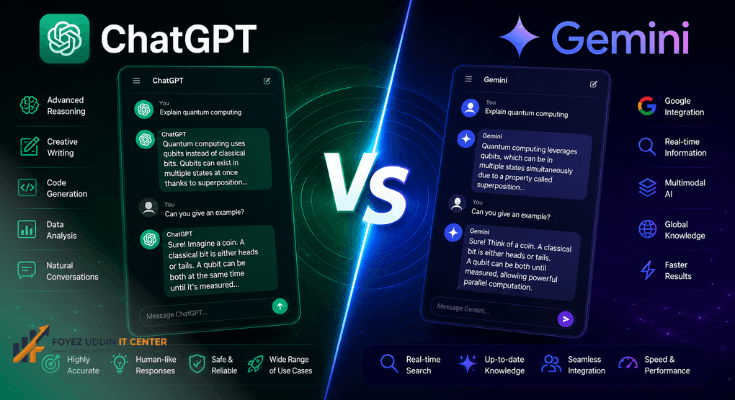
If you’re already paying for one AI assistant and wondering whether the other one does the job better, the ChatGPT vs Gemini question is probably the one on your mind, and you’re not alone in asking it. The honest answer is it depends on what you actually use it for. Both tools have matured into capable, everyday assistants, but they’re built by companies with different priorities, and that shows in how each one performs on writing, research, coding, and image tasks. This guide breaks down the real differences so you can stop guessing and pick the one that fits your workflow.
There’s no shortage of surface-level ChatGPT vs Gemini roundups online, most of which just list features side by side without explaining why any of it matters day to day. This one is different: every section below is built around a specific task: writing, research, coding, and images, so you can jump straight to the category you actually care about.
Quick Verdict
If you want the short version of ChatGPT vs Gemini: ChatGPT tends to be the stronger all-around writer and coder, with a larger ecosystem of plugins and custom GPTs. Gemini tends to win if you already live inside Google Workspace, need current information pulled from the web by default, or want tight integration with Docs, Gmail, and Sheets. Neither is objectively “better”; the right pick depends on which ecosystem you’re already in and what you’re using it for. Keep that framing in mind as you work through the rest of this ChatGPT vs Gemini breakdown, since the details below build on it category by category.
ChatGPT vs Gemini: What Each One Actually Is
ChatGPT is OpenAI’s conversational AI assistant, built on the GPT family of models. It launched in late 2022 and has since expanded into a broader platform that includes custom GPTs, a plugin-style tool ecosystem, voice mode, and API access for developers. You can read more about the underlying models on OpenAI’s official site.
Gemini is Google’s answer, replacing the earlier Bard product. It’s built on Google’s Gemini model family and is woven directly into Google’s own products Search, Docs, Gmail, and Android. Google positions Gemini as a multimodal-first assistant, meaning it was designed from the ground up to handle text, images, and other formats together rather than bolting multimodal support on later. Details on the current model lineup are available on Google’s Gemini page.
The core distinction in any ChatGPT vs Gemini discussion comes down to design philosophy: OpenAI built a standalone assistant that plugs into many things, while Google built an assistant that’s native to the tools millions of people already use daily.
Both companies release new model versions frequently, and each release tends to shift the balance slightly. A capability gap that existed six months ago may have closed by the time you’re reading this, which is part of why so many ChatGPT vs Gemini comparisons age quickly. The categories below focus on structural differences, how each product is built, and where it’s integrated since those tend to hold steadier than any specific benchmark claim.
It’s also worth noting that both companies offer more than one model tier within their own lineups. OpenAI typically offers a faster, lighter model alongside a more capable (and slower) reasoning-focused model, and Google does the same with its Gemini family. When you read a claim about “ChatGPT” or “Gemini” performance anywhere, including in this article, it’s worth checking which specific model tier is being referenced, since a comparison between a free-tier model and a premium one isn’t really an apples-to-apples test.
ChatGPT vs Gemini: Writing & Content Quality
Writing quality is the single most common reason people compare ChatGPT vs Gemini in the first place, since it’s the task both tools get used for the most.
ChatGPT has generally been regarded as the more versatile writer. It tends to handle tone shifts well; asking it to write casually, then formally, then persuasively usually produces noticeably different output rather than the same structure with different words swapped in. It’s also generally strong at maintaining a consistent voice across a long piece, which matters if you’re drafting anything longer than a few paragraphs.
Gemini has improved substantially on writing quality in recent versions, and reviewers at outlets like The Verge have noted it closing the gap on general-purpose writing tasks. Where Gemini tends to stand out is in tasks that benefit from grounding writing that references current events, recent product releases, or anything where being up to date actually matters, since Gemini can pull in fresher context more readily than a model relying purely on training data.
Neither model is dramatically “better” at writing in a way that would be obvious to a casual user. The differences show up more in edge cases: highly technical writing, creative fiction with a distinct voice, or long-form pieces that need to stay coherent across many pages. If writing quality is your main decision factor in the ChatGPT vs Gemini debate, the practical advice is to run the same prompt through both on a free tier and compare the output on your actual use case, since quality can vary by task type.
One thing worth testing yourself: editing and revision. Ask either tool to cut a piece of writing by 30% without losing meaning or to rewrite something in a specific person’s voice. Both ChatGPT and Gemini can do this, but how well they preserve nuance under those constraints is one of the more telling ways to compare their actual writing skill rather than just their first-draft output.
Formatting habits differ slightly too. ChatGPT tends to default to structured output headers, bullet points, and bold text, even when a plain paragraph would read better, unless you explicitly ask for prose. Gemini has historically leaned a bit more conversational by default in its Workspace-integrated form, closer to how it would appear inside a Gmail draft or a Doc. Neither habit is wrong, but it’s worth knowing going in if you have a strong formatting preference.
ChatGPT vs Gemini: Research & Real-Time Information
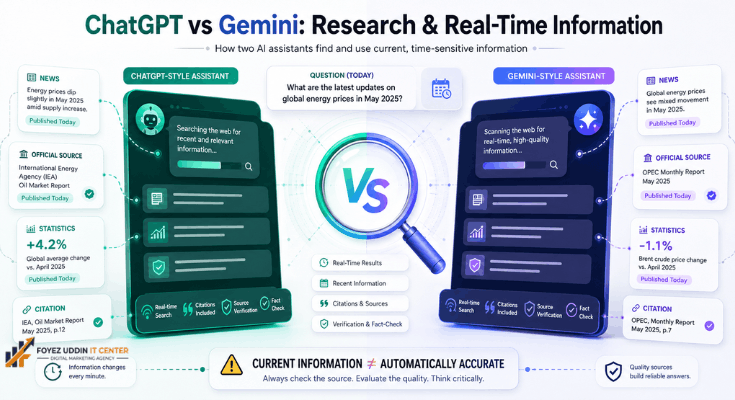
This is one of the more clear-cut differences between the two. Gemini has an advantage here by default, because of its native integration with Google Search. When you ask about something current, it’s generally better positioned to surface recent, sourced information without extra setup.
ChatGPT can also browse the web and pull current information, but this typically requires the feature to be explicitly enabled or triggered, and its search integration (through Bing-based browsing) doesn’t have quite the same depth of index that Google’s own search infrastructure provides for Gemini.
For research-heavy tasks like summarizing a recent news story, checking current statistics, or finding sources on an ongoing event, Gemini’s tighter connection to search tends to give it an edge. For research that draws on reasoning over provided documents or established knowledge rather than needing today’s headlines, the gap narrows considerably.
If your work depends heavily on real-time accuracy, this is one of the more decisive factors in the ChatGPT vs Gemini comparison, and it’s worth weighting more heavily than general writing style.
There’s a practical test you can run yourself: ask both tools about something that happened in the last week, a product launch, a sports result, or a market move, and see which one gives you a sourced, current answer without you having to ask it to search first. That single test tends to be more revealing than any general claim about “research ability,” because it shows you the default behavior you’ll actually experience in daily use.
It’s also worth separating “current information” from “source quality.” A tool can pull recent information and still summarize it inaccurately or cite a low-quality source. Whichever assistant you land on, treat anything time-sensitive or high-stakes medical, legal, or financial information especially as a starting point for your own research rather than a final answer, regardless of which side of the ChatGPT vs Gemini comparison you land on.
ChatGPT vs Gemini: Coding Ability
Coding is where ChatGPT has historically held a stronger reputation, particularly for developers doing exploratory work debugging, refactoring, explaining unfamiliar codebases, or scaffolding a new project. Its code suggestions tend to include more contextual explanation by default, which is useful when you’re learning as you go.
Gemini has made real gains in coding, especially for tasks tied to Google Cloud services or when working inside Google’s own developer tools. If your stack already involves Firebase, Google Cloud Platform, or Android development, Gemini’s familiarity with that ecosystem can save time that a general-purpose coding assistant might not.
For pure algorithmic problem-solving and general-purpose programming across languages, ChatGPT is still commonly cited by developers as the more reliable option, though this is an area where both models update frequently enough that any specific claim should be verified against current benchmarks rather than taken at face value. Independent coverage from outlets like TechCrunch is a reasonable place to check for updated comparisons as new model versions ship.
Beyond raw output quality, workflow matters. ChatGPT’s integration with code editors through extensions and its API make it straightforward to wire into an existing development pipeline. Gemini’s advantage shows up more in specific, integrated contexts; for example, if you’re already writing Apps Script for Google Sheets or building on Firebase, having an assistant that understands that environment natively can be a genuine time-saver over a general-purpose coding tool.
For most developers weighing ChatGPT vs Gemini for daily coding work, the practical test is the same as with writing: try both on a real task from your own codebase, not a toy example, since general reputation doesn’t always predict how a model handles your specific stack, style, or internal conventions. This is one area where the ChatGPT vs Gemini gap can shift quickly as new model versions ship, so treat any specific claim as a snapshot rather than a permanent ranking.
ChatGPT vs Gemini: Image & Multimodal Features
Both platforms support image generation and image understanding, but they approach it differently.
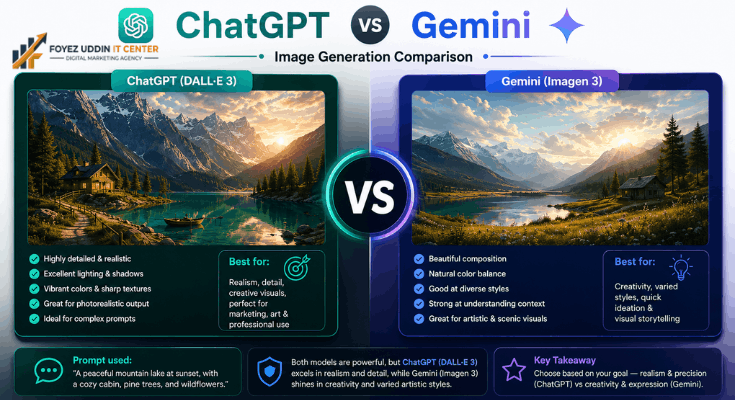
ChatGPT’s image generation, powered by DALL-E-family models integrated into the chat interface, is generally praised for following detailed prompts accurately and handling text-in-image requests (like generating a logo with specific wording) better than most competitors.
Gemini’s multimodal capability is arguably its core design principle rather than an add-on; it was built to reason across text, images, and other inputs together from the start. This shows up in tasks like uploading a photo and asking detailed follow-up questions about it, or combining an image with a text prompt in a single request. Google’s own documentation on multimodal capabilities is available through Google’s AI product pages.
For pure image generation quality and prompt-following, ChatGPT tends to get the nod in most side-by-side comparisons. For fluid reasoning across mixed media images, text, and documents together in one conversation, Gemini’s native multimodal design tends to feel more seamless. This is a genuinely close call in the broader ChatGPT vs Gemini conversation, and personal preference plays a bigger role here than in most other categories.
If your use case is mostly generating standalone images, social graphics, product mockups, or illustrations, spend your testing time on prompt-following accuracy and how well each tool handles revisions (“make it warmer,” “remove the text,” or “change the angle”). If your use case is more about understanding existing images, extracting data from a screenshot, analyzing a chart, or reading handwriting in a photo, that’s closer to Gemini’s core strength, and it’s worth testing directly on your own images before committing to either platform.
ChatGPT vs Gemini: Integration (Google Workspace vs OpenAI Ecosystem)
This is arguably the most practical factor for a lot of people, and it’s less about raw capability than about where the tool fits into your existing workflow.
Gemini is built into Google Workspace. Docs, Sheets, Gmail, Slides, and Meet all have Gemini features available directly inside the app, assuming your plan includes them. If your work already lives in Google’s ecosystem, this integration alone can outweigh small differences in raw model quality, since you’re not switching tabs or copy-pasting between tools.
ChatGPT’s integration story is different: it has custom GPTs, a growing plugin and connector ecosystem, and API access that developers use to build ChatGPT into third-party apps and internal tools. It’s less “built into the software you already use” and more “a flexible hub you can connect other things to.” For developers and businesses building custom AI-powered workflows, this flexibility is often the deciding factor.
Neither approach is strictly better; it depends on whether you want AI embedded in tools you already have or a standalone assistant you extend yourself.
This is worth thinking through concretely rather than abstractly. If a typical workday for you involves drafting emails in Gmail, editing a shared doc, and pulling numbers into a sheet, Gemini’s presence inside each of those apps removes a lot of copy-pasting. If your work is more centered on a specific external tool, a project management app, a CRM, or a custom internal dashboard, ChatGPT’s connector and API flexibility may fit better since you’re not limited to what Google chooses to integrate.
Enterprises evaluating ChatGPT vs Gemini at an organizational level should also weigh admin controls, data handling policies, and compliance certifications, all of which differ between OpenAI’s and Google’s business offerings and are worth reviewing directly with each vendor’s sales or documentation team before rolling either tool out company-wide.
ChatGPT vs Gemini: Pricing Compared
Pricing is one of the fastest-changing aspects of both products, so treat the figures below as a general shape rather than exact current numbers. Always verify current pricing on the official OpenAI pricing page and Google’s Gemini pricing page before deciding.
Again, verify current pricing and plan details directly with OpenAI and Google, since both companies adjust tiers and included features regularly.
Broadly speaking, if you’re already paying for Google Workspace, adding Gemini’s premium tier can feel like a smaller incremental cost since it layers onto a subscription you already have. If you’re not in the Google ecosystem, ChatGPT’s standalone subscription is a more direct like-for-like comparison. This pricing structure is a recurring theme in almost every ChatGPT vs Gemini cost breakdown you’ll find online.
A useful way to compare cost isn’t just the sticker price but what you’d actually be paying for twice. If you already have a Google One or Workspace subscription that includes Gemini, adding a separate ChatGPT subscription means paying for two assistants rather than one worth factoring in before assuming either option is the “cheaper” one in isolation.
ChatGPT vs Gemini: Which Should You Choose
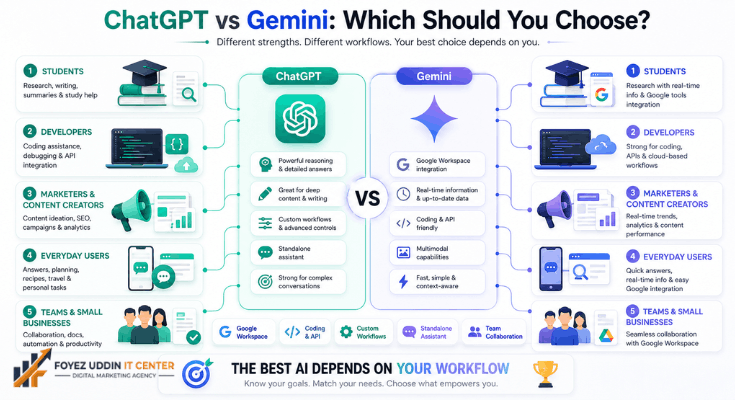
Students: Gemini’s tight Google Docs and Search integration is genuinely convenient if your coursework already lives in Google Classroom or Docs. ChatGPT is a strong alternative if you want a standalone tool for brainstorming, essay drafts, or study explanations independent of any particular platform.
Developers: ChatGPT is generally the more commonly recommended pick for general-purpose coding help and its API ecosystem, though Gemini is worth serious consideration if your stack is built on Google Cloud, Firebase, or Android.
Marketers and content creators: Both handle drafting, outlining, and editing well. If your workflow includes Google Sheets for reporting or Gmail for outreach, Gemini’s integration can save real time. If you rely more on custom GPTs for repeatable workflows (a specific brand voice GPT, for example), ChatGPT’s customization options are hard to match.
Casual, everyday users: This often comes down to what’s already on your phone or in your browser. Android and Google Workspace users will find Gemini frictionless. iPhone users or anyone who wants a single, consistent assistant across platforms may prefer ChatGPT’s standalone app.
Teams and small businesses: If your team already collaborates in Google Docs and Sheets, Gemini’s presence inside those tools reduces friction for everyone, not just power users. If your team relies on a mix of tools outside Google’s ecosystem, ChatGPT’s broader connector support and API access give more flexibility to build custom workflows around whichever apps you already use.
There’s no universal winner in the ChatGPT vs Gemini debate; the right choice tracks closely with your existing tools and the specific tasks you do most often. Some people end up using both, treating ChatGPT as their go-to for drafting and coding help and Gemini as the assistant that lives inside their inbox and documents.
Conclusion
The ChatGPT vs Gemini decision isn’t really about which model is “smarter.” In the abstract, both are capable, well-funded, frequently updated products from companies with strong research teams. It’s about fit: ChatGPT tends to suit people who want a flexible, standalone assistant with strong writing and coding chops and a big customization ecosystem. Gemini tends to suit people already living inside Google’s tools who want research grounded in current search results and integration that doesn’t require switching apps.
If you’re still unsure after reading this, the fastest path to a real answer is to try the free tier of whichever one you’re not currently using, run it against the tasks you do most often, and see which output you’d actually want to keep. Whichever direction you lean, revisit this ChatGPT vs Gemini comparison periodically; both products change quickly enough that today’s gaps can close within a few months.
Frequently Asked Questions
Here are the questions that come up most often when people are researching ChatGPT vs Gemini before choosing a subscription.
Is ChatGPT or Gemini better overall?
Neither is universally better; it depends on your use case. In the broader ChatGPT vs Gemini comparison, ChatGPT tends to lead in general writing versatility and coding, while Gemini tends to lead in real-time information and Google ecosystem integration.
Which is free to use?
Both ChatGPT and Gemini offer free tiers with usage limits. Paid tiers unlock more advanced models and higher usage caps on each platform. Verify current limits directly with OpenAI and Google, since they change.
Can Gemini access the internet in real time?
Yes, by default Gemini is more tightly connected to Google Search, which generally gives it an advantage for current events and up-to-date research tasks compared to ChatGPT’s browsing feature.
Is ChatGPT better for coding than Gemini?
ChatGPT has a stronger general reputation for coding help across languages and frameworks, though Gemini performs well within Google’s own developer ecosystem (Firebase, GCP, Android). Always check current benchmarks, since both models update often.
Do I need a Google account to use Gemini?
Yes, Gemini requires a Google account, and its deepest features are tied to Google Workspace integration.
Which one should a small business choose?
It depends on your existing tools. Businesses already using Google Workspace often find Gemini’s integration reduces friction, while businesses wanting a standalone assistant with a flexible API and plugin ecosystem often lean toward ChatGPT.
Can I switch between ChatGPT and Gemini without losing my work?
Yes, but conversation history and custom settings don’t transfer between them, since they’re separate products from separate companies. Many people comparing ChatGPT vs Gemini end up keeping a free account on both and switching based on the task, rather than committing exclusively to one.
Is one of them safer or more private than the other?
Both OpenAI and Google publish their own data usage and privacy policies, and both have enterprise tiers with stricter data handling than their free consumer tiers. If privacy is a deciding factor in your ChatGPT vs Gemini choice, read each company’s current privacy policy directly rather than relying on general reputation, since policies are updated periodically.

One Comment on “ChatGPT vs Gemini: The Honest, Definitive Comparison”