
ChatGPT prompt engineering is the skill that separates people who get generic, disappointing answers from people who get exactly what they need from AI. If you’ve ever typed a question into ChatGPT and gotten a vague or unhelpful response, the problem usually isn’t the AI; it’s the prompt. In this guide, we’ll break down ChatGPT prompt engineering step by step, so you can start writing prompts that consistently produce better, more accurate, and more useful results.
Whether you’re a student, marketer, developer, or business owner, mastering prompt engineering is one of the highest-leverage skills you can learn in 2026.
What Is ChatGPT Prompt Engineering?
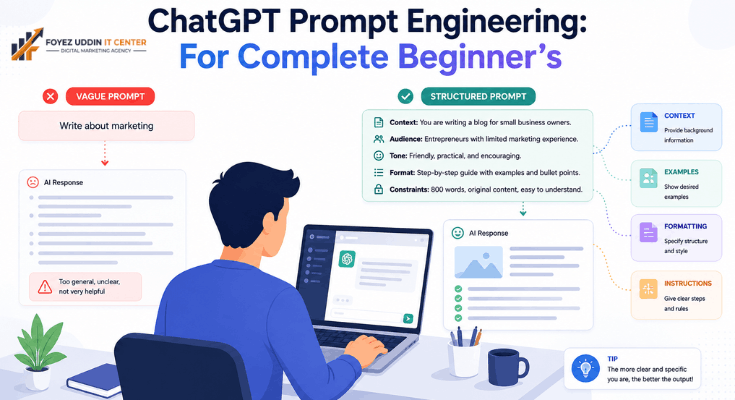
ChatGPT prompt engineering is the practice of crafting clear, structured, and specific instructions (prompts) to guide an AI model toward the best possible response. Instead of typing a vague question, prompt engineering involves adding context, examples, constraints, and formatting instructions so the AI understands exactly what you want.
In simple terms, ChatGPT prompt engineering is the difference between asking, “Write about marketing” and asking, “Write a 300-word blog introduction about email marketing for small e-commerce businesses in a friendly and persuasive tone.” “The second prompt, shaped by good ChatGPT prompt engineering, will almost always produce a far better result.
Why Does ChatGPT Prompt Engineering Matter?
AI models like ChatGPT are powerful, but they can’t read your mind. They respond based entirely on the input you give them. That’s why ChatGPT prompt engineering matters so much:
- Better accuracy: Clear prompts reduce vague or incorrect answers.
- Time savings: A well-engineered prompt often eliminates the need for multiple follow-up corrections.
- Consistency: Good prompt engineering produces reliable results across similar tasks.
- Better formatting: You can control tone, length, structure, and style with the right prompt.
- Unlocks advanced use cases: From coding to data analysis, prompt engineering helps ChatGPT perform specialized tasks correctly.
Simply put, learning prompt engineering turns ChatGPT from a basic chatbot into a genuinely powerful assistant.
Core Principles of ChatGPT Prompt Engineering
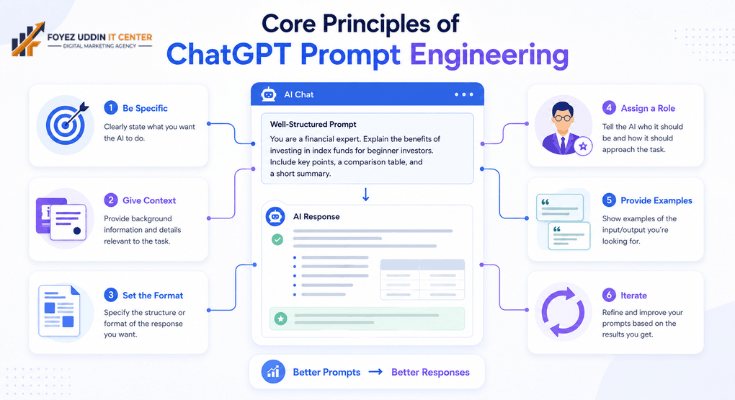
Good ChatGPT prompt engineering is built on a few core principles:
- Be specific: Vague prompts produce vague answers.
- Give context: Explain who the answer is for and why you need it.
- Set the format: Ask for bullet points, tables, headings, or a specific word count.
- Assign a role: Ask ChatGPT to “act as” an expert (e.g., “act as a career coach”).
- Provide examples: Show the AI a sample of the tone or style you want.
- Iterate: Refine your prompt based on the first response.
These six principles form the foundation of effective prompt engineering, no matter what task you’re working on.
Step-by-Step: How to Write Better ChatGPT Prompts
Here’s a simple framework for ChatGPT prompt engineering that works for almost any task:
Step 1: Define the goal What exactly do you want ChatGPT to produce? A blog post, code snippet, email, or summary?
Step 2: Add context Who is this for? What’s the purpose? The more background you give, the better the output.
Step 3: Specify format and tone Do you want a list, a table, a formal tone, or a casual tone?
Step 4: Set constraints: word count, length, specific keywords, or things to avoid.
Step 5: Review and refine If the first response isn’t perfect, adjust your prompt and try again.
Following this structure is the fastest way to improve your prompt engineering skills in real time.
ChatGPT Prompt Engineering Examples
Here are a few before-and-after examples that show ChatGPT prompt engineering in action:
Weak prompt: “Write a resume summary.” Strong prompt with ChatGPT prompt engineering: “Write a 3-sentence resume summary for a marketing manager with 5 years of experience in digital advertising, targeting a senior marketing role at a tech startup.”
Weak prompt: “Explain machine learning.”
Strong prompt: “Explain machine learning to a complete beginner using a simple analogy in under 150 words.”
Weak prompt: “Give me a workout plan.”
Strong prompt: “Create a 3-day beginner workout plan for someone with no gym equipment, focused on building strength, formatted as a table.”
These examples show how small changes, guided by prompt engineering best practices, dramatically improve output quality.
Common ChatGPT Prompt Engineering Techniques
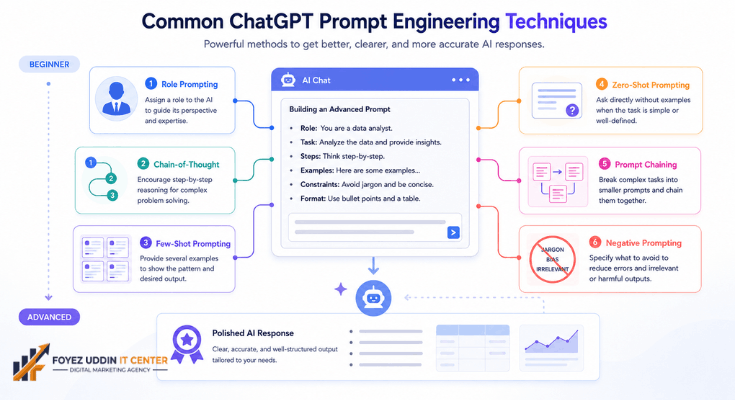
There are several advanced techniques used in professional prompt engineering:
- Role prompting: “Act as an experienced copywriter…”
- Chain-of-thought prompting: Asking ChatGPT to “think step by step” before answering.
- Few-shot prompting: Providing 2–3 examples so ChatGPT can match the pattern.
- Zero-shot prompting: Asking directly without examples, relying on clear instructions.
- Prompt chaining: Breaking a complex task into multiple connected prompts.
- Negative prompting: Telling ChatGPT what to avoid (e.g., “don’t use jargon”).
Mastering these techniques takes your prompt engineering skills from the beginner to the advanced level.
ChatGPT Prompt Engineering Mistakes to Avoid
Even with good intentions, many people get poor results because of these common mistakes in ChatGPT prompt engineering:
- Being too vague, “Write something good,” gives ChatGPT nothing to work with.
- Overloading one prompt: Asking for too many things at once confuses the output.
- Skipping context: Not explaining the purpose or audience.
- Ignoring format: Forgetting to specify structure, length, or tone.
- Not iterating: Accepting the first response instead of refining the prompt.
Avoiding these mistakes is just as important as learning the techniques themselves when practicing prompt engineering.
Best Use Cases for ChatGPT Prompt Engineering
ChatGPT prompt engineering is useful across almost every industry and task, including:
- Content writing and blogging
- Marketing copy and ad creation
- Coding and debugging
- Data analysis and summarization
- Customer support scripting
- Resume and cover letter writing
- Lesson planning and tutoring
- Business strategy brainstorming
No matter the use case, strong prompt engineering consistently leads to faster, more accurate, and more useful AI output.
How to Practice ChatGPT Prompt Engineering
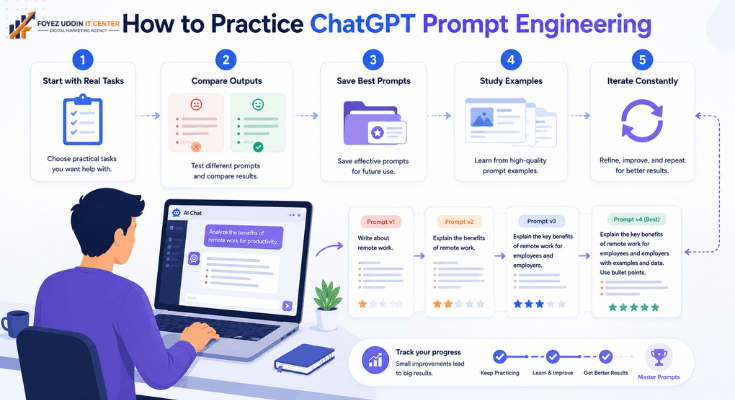
Like any skill, ChatGPT prompt engineering improves with practice. Here’s how to get better:
- Start with real tasks: Practice on things you actually need, like emails or reports.
- Compare outputs: Test two versions of a prompt and see which performs better.
- Save your best prompts: Build a personal library of prompts that consistently work well.
- Study examples: Look at prompt templates shared by other users and adapt them.
- Iterate constantly: Treat every response as a draft you can refine further.
Consistent practice is the real secret behind advanced prompt engineering; it’s less about memorizing tricks and more about developing a habit of clarity.
Conclusion
ChatGPT prompt engineering isn’t a complicated technical skill reserved for developers; it’s a practical, learnable habit that anyone can use to get dramatically better results from AI. By being specific, providing context, setting clear formats, and refining your prompts through iteration, you can turn ChatGPT into a genuinely powerful tool for writing, planning, coding, and problem-solving. Start applying the principles of ChatGPT prompt engineering covered in this guide today, and you’ll immediately notice sharper, more useful responses.
FAQs
Q1: What is ChatGPT prompt engineering?
A: It’s the practice of writing clear, specific, and well-structured prompts to get better, more accurate responses from ChatGPT.
Q2: Do I need coding skills for ChatGPT prompt engineering?
A: No. Prompt engineering is a writing and communication skill, not a technical coding skill.
Q3: What makes a good ChatGPT prompt?
A: A good prompt is specific, provides context, defines the format or tone, and sets clear constraints like length or audience.
Q4: How can I improve my ChatGPT prompt engineering skills?
A: Practice on real tasks, compare different prompt versions, and refine your prompts based on the responses you get.
Q5: Is ChatGPT prompt engineering a valuable career skill?
A: Yes. As more businesses adopt AI tools, the ability to write effective prompts is increasingly valuable across marketing, writing, coding, and customer service roles.
Q6: Can ChatGPT prompt engineering techniques be used with other AI tools?
A: Yes. Most prompt engineering principles, clarity, context, format, and iteration, apply to other AI models like Claude and Gemini as well.


2 Comments on “ChatGPT Prompt Engineering: For Complete Beginner’s”