
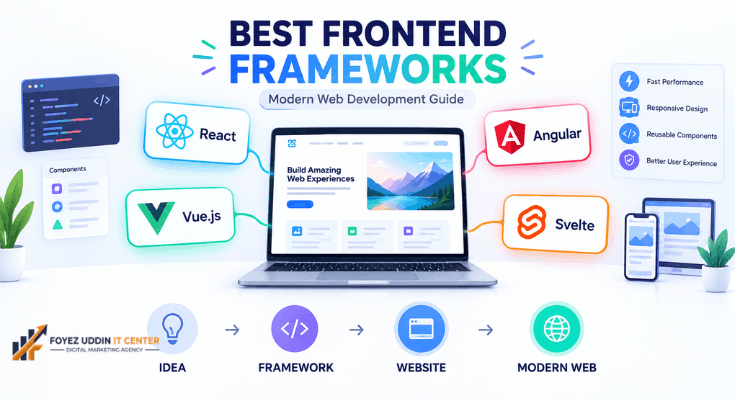
Building a website used to require years of coding experience. That is no longer true.
Today, the best frontend frameworks make it possible for beginners, bloggers, and small business owners to build professional websites. You do not need a computer science degree. You just need the right tool and a little patience.
This guide breaks down everything in plain English. No jargon. No assumptions. Just clear answers about the best frontend frameworks available right now.
By the end, you will understand which framework fits your goals. You will also know how to get started today.
What Is a Frontend Framework, Really?
Think of a website like a house. The frontend is everything you see and touch. The buttons, the colors, the layout, and the text.
A frontend framework is a pre-built toolkit. It gives you ready-made pieces instead of building everything from scratch.
For example, imagine assembling furniture. You could carve every piece of wood yourself. Or you could use a flat-pack kit with pre-cut parts. Frameworks are the flat-pack kit for websites.
This matters because it saves time. It also reduces mistakes. Beginners get a head start instead of starting from zero. This is exactly why picking one of the best frontend frameworks matters so much for your first project.
Why Should Non-Coders Care About This?
You might be thinking, “I am not a developer. Why does this concern me?”
Here is the truth. Modern website builders and no-code tools are often built on top of these frameworks. Understanding the basics helps you make smarter choices.
For instance, when you pick a website builder, you are often choosing a framework indirectly. Knowing the differences helps you avoid future headaches.
Therefore, this knowledge is not just for developers. It is for anyone making decisions about their online presence, including deciding which of the best frontend frameworks powers their chosen platform.
The Best Frontend Frameworks for Modern Web Development
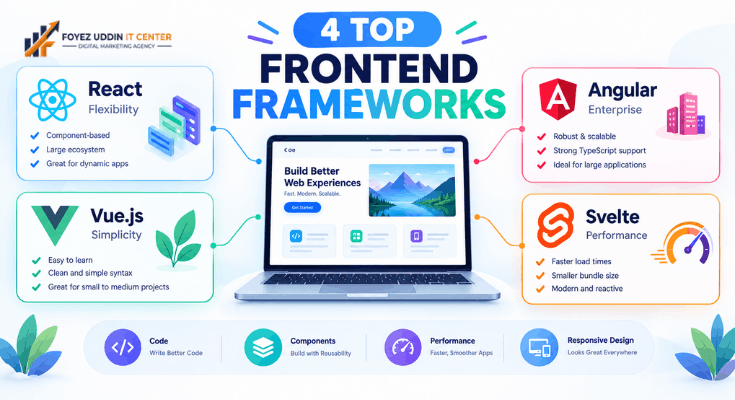
Let us look at the top contenders. Each one has strengths and weaknesses.
1. React: The Popular Choice
React was created by Facebook (now Meta). It is currently one of the most widely used frontend frameworks in the world.
Key strengths:
- Massive community support
- Huge library of pre-built components
- Backed by a major tech company
- Flexible for small or large projects
However, React has a learning curve. It requires understanding JavaScript concepts. For non-coders, this can feel intimidating at first.
For beginners without coding plans, React is best used through no-code platforms that run on it, like certain website builders. Many people searching for the best frontend frameworks land on React first because of its popularity.
2. Vue.js: The Beginner-Friendly Option
Vue.js is often praised for its simplicity. Many developers call it the easiest framework to learn.
Why beginners like Vue:
- Clean, readable syntax
- Excellent documentation
- Gentle learning curve
- Lightweight and fast
Vue strikes a balance. It is powerful enough for real projects. Yet, it remains approachable for newcomers.
For small business owners exploring development for the first time, Vue is a strong entry point. Among the best frontend frameworks for beginners, Vue consistently ranks at the top.
3. Angular: The Enterprise Powerhouse
Angular is maintained by Google. It is a full-featured framework built for large, complex applications.
Angular’s advantages:
- Comprehensive built-in tools
- Strong structure and organization
- Great for large teams
- Long-term corporate support
That said, Angular is not ideal for absolute beginners. It has a steep learning curve. Small business owners with simple needs may find it overwhelming. Still, it remains one of the best frontend frameworks for larger, enterprise-grade websites.
4. Svelte: The Rising Star
Svelte takes a different approach. Instead of running code in the browser, it compiles your website into fast, efficient code ahead of time.
Why Svelte stands out:
- Extremely fast performance
- Less code to write
- Growing popularity among developers
- Simple, intuitive syntax
For non-tech-savvy users, Svelte is worth watching. It is simpler than React or Angular. However, it has a smaller community currently. It is quickly becoming one of the best frontend frameworks for speed-focused projects.
Comparing the Best Frontend Frameworks at a Glance
Here is a quick summary table for easy comparison.
| Framework | Best For | Difficulty | Community Size |
| React | Flexibility, popularity | Medium | Very Large |
| Vue.js | Beginners, simplicity | Easy | Large |
| Angular | Enterprise apps | Hard | Large |
| Svelte | Performance, modern projects | Easy-Medium | Growing |
This table helps you compare options quickly. Therefore, you can match your skill level with the right tool.
How Should Non-Coders Actually Build a Website?
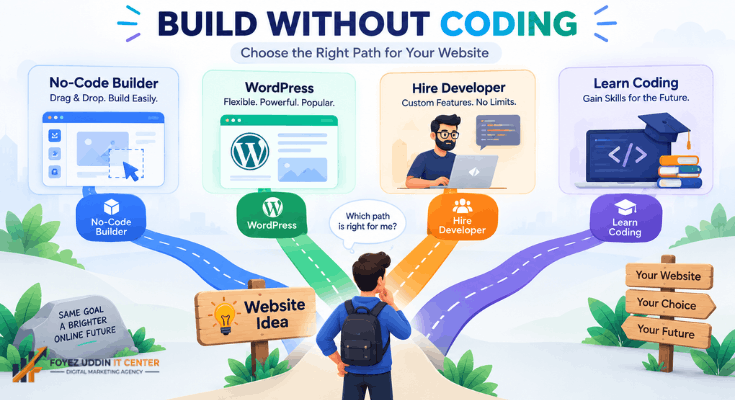
Here is the honest truth. Most non-coders should not learn a framework directly.
Instead, consider these paths:
- No-code website builders (Wix, Squarespace, Webflow)
- WordPress with visual page builders
- Hiring a freelance developer for custom needs
- Learning basics through guided courses, if curious
However, understanding frameworks still helps. It allows you to communicate clearly with developers. It also helps you choose the right platform.
For example, if a developer says your site “uses React,” you will understand what that means. This knowledge builds confidence, even without hands-on coding.
If you want to go deeper, the official React documentation and Vue.js guide are great starting points once you’re ready to explore the best frontend frameworks hands-on.
Factors to Consider When Choosing a Framework
Choosing the best frontend frameworks depends on your specific situation. Consider these factors carefully.
- Your technical skill level: Are you comfortable learning new concepts?
- Project complexity: Is this a simple blog or a complex application?
- Long-term goals: Do you plan to scale the website later?
- Community and support: Will you find help when stuck?
- Time investment: How much time can you dedicate to learning?
For instance, a blogger needing a simple site should avoid Angular. Meanwhile, a startup building a complex app might benefit from React’s flexibility.
Common Mistakes Beginners Make
Many beginners jump into the wrong framework. This leads to frustration and wasted time.
Avoid these mistakes:
- Choosing a framework because it is trendy, not because it fits your needs
- Skipping the fundamentals of HTML and CSS
- Ignoring documentation and tutorials
- Trying to build complex projects too soon
- Comparing yourself to experienced developers
Instead, start small. Build simple projects first. Gradually increase complexity as your confidence grows. This approach works well regardless of which of the best frontend frameworks you eventually choose.
The Future of Frontend Frameworks
Frontend development continues to evolve rapidly. New tools emerge every year.
However, the fundamentals remain constant. Frameworks exist to simplify building websites. They reduce repetitive work. They improve performance.
Therefore, learning the basics today prepares you for tomorrow. Even if specific frameworks change, the underlying concepts stay relevant. Staying informed about the best frontend frameworks helps you future-proof your website decisions.
Final Thoughts on the Best Frontend Frameworks
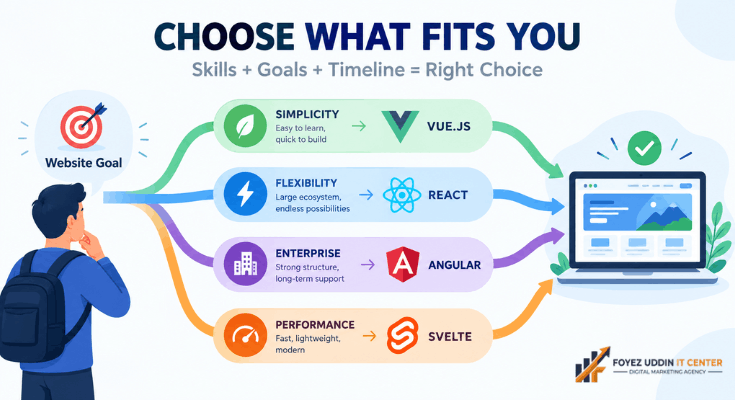
Choosing among the best frontend frameworks does not have to be overwhelming. Start by understanding your goals.
If you want simplicity, consider Vue.js. If you want flexibility and community support, consider React. If you are building something large and complex, Angular might fit. If performance matters most, explore Svelte.
However, remember this. Most non-coders do not need to master these frameworks directly. Instead, use this knowledge to make smarter platform choices.
Ultimately, the right framework is the one that matches your skills, goals, and timeline. Start small, stay curious, and build confidently.
Frequently Asked Questions
1. What is the easiest frontend framework for beginners?
Vue.js is widely considered the easiest. It has simple syntax and excellent documentation.
2. Do I need to know coding to use a frontend framework?
Yes, frameworks require basic JavaScript knowledge. Non-coders should use no-code builders instead.
3. Which framework is best for small business websites?
Vue.js, or a no-code platform built on React, works well for most small businesses.
4. Is React better than Angular?
It depends on your project. React offers flexibility. Angular offers structure for large applications.
5. Can I switch frameworks later if I change my mind?
Yes, but switching requires rebuilding parts of your site. Choose carefully from the start.
6. Are frontend frameworks free to use?
Yes, React, Vue, Angular, and Svelte are all free and open source.
7. How long does it take to learn a frontend framework?
Basic proficiency typically takes two to three months with consistent practice.
8. What is the difference between a framework and a website builder?
A framework is a coding toolkit. A website builder is a visual, no-code tool often built using frameworks.